

Overview
Dr. George E. Shipman and his wife opened the Foundlings Home in 1871. The Shipmans were, according to many newspaper accounts and primary sources, inspired by the work of George Müller in Bristol and Dr. Charles Cullis in Boston.
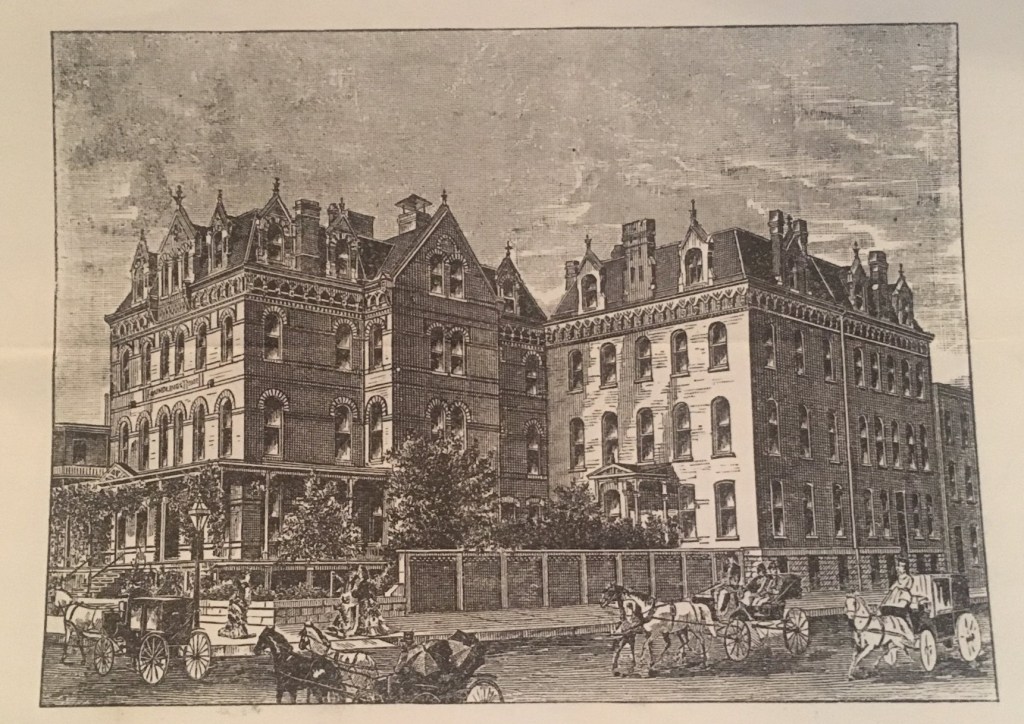
In 1874, the organization moved to a four-story building at 115 South Wood Street in Chicago, later 15 South Wood Street—when Chicago changed its street numbering systems (one of the times—this happened quite a few times in the city’s history).[1] The Home was near the Brown School and developed a partnership with the school. Frances Shipman, the daughter of Dr. Shipman, taught sixth grade at the Brown School. “When the Home was opened, its main object was to save the forsaken children, and it was not considered best to give any way. But it was not many months before it was made apparent to us that such was not the will of our Heavenly Father, and since then the children have been given to those who offered them Christian homes; and who can estimate the blessings which these little ones have carried with them into the homes of their adoption… More than three hundred children have been given into professedly Christian families.”[2]
In 1971, at exactly 100 years old, the Home closed because of pregnancy prevention, the number of babies born out of wedlock, and the greater acceptance of single motherhood. The following year, the building was sold to Rush-Presbyterian-St. Luke’s Medical Center for use as a mental health treatment center.
In 1960, a new home was built at 1720 W. Polk.[3] By 1962, the Foundlings Home “provides a maternity home for unwed mothers, a nursery and a detailed adoption program, among other services.”[4]
The charity is still active as the Chicago Foundlings Home. Currently, the organization works to support charitable organizations that provide education, care, and other services in communities to expecting mothers, mothers, children, and infants.

Institution Name and Type
Alternative Names:
- Chicago Foundlings Home
- Chicago Foundlings’ Home
Goal/Objects:
- 1905: “To care for abandoned infants and homeless mothers with infants.”[5]
Type of Institution:
- Dependent : Children : Orphanage
- Dependent : Homeless : Women
- Dependent : Women : Mothers
- 1905:
- Class II. Relief for Destitute, Neglected and Delinquent Children—Division I. Asylums, Homes, and Cheap Lodgings for Children[6]
Location and Building
Address: 15 South Wood
- 1871, before April: 266 South Green Street[7]
- 1871, after April: 268 West Randolph Street[8]
- 1874-1960: 15 South Wood Street
- 1905: 144 S. Wood Street[9]
Locality: Chicago
County: Cook
State: Illinois
Notes on the buildings:
Administration Information
Date of Founding: 30 January 1871
Date of Residential Institution Closure: 1971
Dates of Name, Place, Mission Change, or Merger: 1874
- Moved to Wood Street
Successor: Chicago Foundlings’ Home Charity
Administration:
- 1910: Private Corporation
Funding and Support: Supported by voluntary contributions.[10]
- The Ladies’ Union Aid Society of the Chicago Foundlings’ Home was established in the first year of the homes’ history and were a group that raised money, knitted and sewed clothing for the infants, and more.
- The Chicago Relief and Aid Society often donated to the home.
- Carter H. Harrison, Cook County Commissioner, donated his entire salary to the Foundlings’ Home in July 1873.[11]
People
Matilda B. Carse, social reformer, leader of the temperance movement, and donor to the Foundlings Home for many years.
C. H. Chase, member of the board in 1879.
E. G. Clark, president in 1905.
Thomas C. Dickerson, one of the corporators of the home.
John Dillingham, one of the corporators of the home.
Dr. T. C. Duncan, served as a physician throughout the 1870s and onwards.
Dr. R. N. Foster, assisted as a physicians in the 1870s when called on.
Rev. C. D. Helmer, one of the corporators of the home.
William G. Hibbard, Esq., one of the corporators of the home and served as President in the 1870s and 1880s. Treasurer in 1905.
Dr. Henrietta A. Howe, resident physician since 1888-at least 1910.
S. A. Kean, one of the corporators of the home and served as President in 1880s.
A. E. Kittredge, one of the corporators of the home.
W. C. McCallum, member of the board in 1879.
Dr. J. P. Mills served as physician throughout the late 1870s and onwards.
Emma A. Peck, matron in 1905.
J. L. Pickard, one of the corporators of the home and President of the Board of Corporators before 1879.
Rev. H. N. Powers, one of the corporators of the home.
Frances F./C. Shipman, Superintendent in 1905, 1910 and 1916.
George E. Shipman, founder and superintendent.
Dr. H. N. Small, assisted as a physicians in the 1870s when called on.
C. A. Weirich, resident physician in 1910.
Dr. C. A. Werrick
Past Residents
Percilla, a blind girl who was in the home since infanthood attended school in 1916
Madeline Elizabeth Hopkins, was adopted from the Chicago Foundling Home by Mary Eva Hopkins.
Cathy Napolitano, professional genealogist and author. She was born in the Chicago Foundlings Home. https://twitter.com/CathyNapolitano. http://cathysgenealogyblog.blogspot.com/2012/.
Judith Rae Glitterman Keeler Radford Larmonwas born in the Chicago Foundling Home.
An Infant, 1879. “An infant, wrapped up comfortably and lying in a basket, was left early last evening on a rear veranda of the residence of Lyman Baird, No. 336 North La Salle Street. It was sent to the Foundlings’ Home.”[12]
Frances Alice Johnson was an infant who was taken to the Foundlings’ Home in 1877 after her mother, who is unfortuanately just named “Mrs. Johnson” in newspaper articles disappeared: “Mrs. Johnson, late of 540 Wabash avenue, whose disappearance was noted in The Inter Ocean of yesterday, has not turned up. The babe she left behind her was taken before Justice Summerfield, who christened it Frances Alice Johnson, and then consigned it to the Foundlings Home. Say, Mrs. Johnson, nobody believes that you’ve been and gone and done what you threatened to do, so please come out of your hiding place and take your baby, and nurse it like a sensible woman. The Foundlings’ Home is pretty full just now, and it can’t be any great satisfaction to you to look in the monthly report and see such an item as: ‘Dec. 13. ‘Nother baby found in the basket to-day. A big policeman flung it in, rang the bell, and run away. Such a sweet little creature, etc.’ There’s no solid comfort in anything like this, Mrs. Johnson, so please go and get that baby.”[13]
Unfortunately, looking at the newspaper article from the day prior, it gives an account of what may have happened to Frances’ birth mother: “Four weeks ago a woman giving the name of Mrs. johnson took furnished room at 560 Wabash avenue. She was a woman about 33 years old, rather tall, had dark hair and eyes and high cheek bones, and usually wore—and did when last seen—a brown stuff dress and light-colored scarf. She paid her rent regularly, and though not very communicative, referred at times to her husband, Frank Johnson, whom, she said rather vaguely, was a patent right’s man, and at present travelling in Iowa. Ten days ago Mrs. Johnson required the services of a medical man, and the result was an addition to the house of Johnson of a healthy female child. The young one throve, and the mother, it is said, seemed attached to it, and got along nicely herself. About 11:30 o’clock yesterday morning Mrs. Johnson left the house, and not having returned late in the afternoon her room was searched, where the child was found, and also a note laid on the table, which stated that the writer would never return, as she had gone out to commit suicide by drowning. While there is a possibility of the woman’s mind having become unsettled, the affair is also suggestive of a case of child desertion, and the police are investigating.”[14]
Intake Information and Requirements
Intake Gender/Sex:
- 1880: Adult females
- Adult females who served as wet nurses, called “nurses” in the Ninth Annual Report: “The most of these have come to us in great sorrow; many entirely disowned by all who once loved and cared for them, were glad to find shelter anywhere… When they can no longer act in the capacity of wet nurses, the most of them go out to service or to work at their trades… but, if, for any cause, they are thrown out of a place, they return to the Home till they can find another place.”[15]
- “Including the latter, and exclusive of the eighty one nurses, fifty friendless or homeless women have been admitted during the year.”[16]
- Adult: Female
- Children: Female, Male
Intake Age:
- 1923: Adults, Children from birth to 5 years
Intake Ethnicity/Race:
- 1910: All
- 1923: All
Intake Specifics: Few commitments by the court; many foundlings placed through Illinois Children’s Home and Aid Society; 1910: Foundlings, and homeless mothers with infants
- 1880: “The most of these [the babies] are taken in during the first month. None older than this would be taken in, if we could help it… sometimes it is left in the vestibule in the middle of the night; sometimes a policeman brings it from a remote part of the city… As far as possible, they are given to wet nurses. It happened once or twice, during 1879, that we had wet nurses enough for all the babies, but it was only for the short time. Generally, we have from five to twenty little ones whom we attempt to bring up by hand. The babies are mostly born in Chicago, though a small proportion of the mothers, as far as they are known to us, are residents of the City. They come from all parts of the State and from other States even, so that, so far as the beneficiaries of the Home are concerned, it is far from being a Chicago Institution.”[17]
Number of Residents:
- 1871: 117 foundlings were received of whom 82 died, 11 were given away, 1 was sent to the County house, 4 were returned to the parents. At the end of the year there was 19 foundligns in the home. Of the residents, 67 were boys and 50 were girls.[18]
- Week of 22 September 1875: Five died at the Foundlings’ Home in the past week.[19]
- 1880: 81 adult women, who served as wet nurses, admitted in the past year.[20]
- 1880: 50 friendless or homeless women admitted during the year.[21]
- 1880-1881: During 1880, the Home took in about 400 babies, mostly under one month old.[22]
- 1910: 100 beds
- 1911:[23]
- Children present at the beginning of the year: 32 male, 23 female
- Children placed by court: 1 female
- Children received otherwise: 115 male, 127 male
- Total children at the beginning of the year: 298
- Children placed in homes during 1911: 42
- Children placed in institutions in 1911: 5
- Children returned to friends: 15
- Children who died: 7
- Children present at the end of 1911: 47
- Children left with mother: 182.
- Adults present at the beginning of the year: 1 male, 56 female.
- Adults admitted during 1911: 299 females
- Adults discharged in 1911: 302 females
- Adults who died in 1911: 1 female
- Adults present at the end of the year: 1 male, 51 females.
- Total adults residing in the institution throughout 1911: 355.
- 1913:[24]
- Children at the beginning of the year: 35 male, 19 female
- Children received during 1913: 92 male, 86 female, 178 total
- Total of children in the institution throughout 1913: 232
- Children placed in homes during 1913: 21
- Children placed in institutions during 1913: 26
- Children returned to fiends during 1913: 18
- Children who died during 1913: 1 male, 2 female
- Children who left with mothers during 1913: 126
- Children who were present at the end of 1913: 38
- Adults present at the beginning of 1913: 46 females
- Adults admitted during 1913: 224
Records
Created by the Chicago Foundling Home
Chicago Foundlings Home Records: Chicago Foundlings Home
Chicago Foundlings Home. https://www.chicagofoundlingshome.org/.
The Chicago Foundlings Home website states that they are in the process of digitizing their collections, but people are welcome to email them on their contact page, and “we will send you a note when our information page is updated and we will share additional resources for you to find the relevant records.”
Chicago Foundlings’ Home Account Book [Manuscript] 1884-1922
Chicago History Museum. https://chhiso.ent.sirsi.net/client/en_US/public/search/detailnonmodal/ent:$002f$002fSD_ILS$002f0$002fSD_ILS:237514/one.
Annual Reports
Ninth Annual Report of the Chicago Foundlings’ Home. 1880. Chicago: Foundlings Home Press. https://www.google.com/books/edition/Annual_Report/CV0nAQAAMAAJ.
- Note: this report begins 89 pages into this digitization.
Tenth Annual Report of the Chicago Foundlings’ Home. 1880. Chicago: Chicago Foundlings’ Home Print. https://www.google.com/books/edition/Annual_Report/CV0nAQAAMAAJ.
- Note: this report begins after the Ninth Annual report in this digitization.
Shipman, George E. 1884. God’s Dealings with the Chicago Foundlings’ Home: Being a History of The First Four Years of the Home, from January 30, 1871, to January 30, 1875. Chicago: The Foundlings’ Home. https://www.google.com/books/edition/Annual_Report/CV0nAQAAMAAJ.
Other Publications
Newspaper articles from the 1870s point to a publication called Record, or the Foundlings’ Record, which was the publication of the home. Much of it is published in The Chicago Tribune.
Faith’s Record was the alumni publication of the Foundlings’ Home since 1877.[25]
Baby in the Basket: A Story of the Chicago Foundlings’ Home and its Future. Chicago: Chicago Foundlings’ Home. Available at the Chicago History Museum. https://chhiso.ent.sirsi.net/client/en_US/public/search/detailnonmodal/ent:$002f$002fSD_ILS$002f0$002fSD_ILS:221233/one.
Chicago Foundlings Home. 1886. “The Foundlings Home Christmas Greeting.” Chicago: Ladies Union Aid Society of the Foundlings Home. Available at the Chicago History Museum. https://chhiso.ent.sirsi.net/client/en_US/public/search/detailnonmodal/ent:$002f$002fSD_ILS$002f0$002fSD_ILS:205933/one.
Books
Bear, Marjorie Warvelle. 2007. “The Chicago Foundlings Home.” Found in A Mile Square of Chicago. Oak Brook: TIPRAC. 170-172. https://www.google.com/books/edition/A_Mile_Square_of_Chicago/jRDCtoygdycC?hl=en&gbpv=0.
Shipman, George E. 1884. God’s Dealings with the Chicago Foundlings’ Home: Being a History of The First Four Years of the Home, from January 30, 1871, to January 30, 1875. Chicago: The Foundlings’ Home. https://www.google.com/books/edition/Annual_Report/CV0nAQAAMAAJ.
Collections
Chicago Public Library
“West [Near West] Side Community Collection.” Repository: Chicago Public Library, Harold Washington Library Center, Special Collections, 400 S. State St., Chicago, IL 60605. https://www.chipublib.org/fa-west-near-west-side-community-collection/.
Sources
Illinois Department of Visitation of Children Placed in Family Homes. 1912. Sixth Annual Report of the Department Visitation of Children Placed in Family Homes, Board of Administration of the State of Illinois, For the Year Ending December 31, 1911. Springfield, Illinois: Illinois State Journal Co. https://www.google.com/books/edition/Report_for_of_the_Department_Visitation/e1I9AQAAMAAJ.
—. 1914. Seventh Annual Report of the Department Visitation of Children Placed in Family Homes, Board of Administration of the State of Illinois, For the Year Ending December 31, 1913. Springfield, Illinois: Illinois State Journal Co. https://books.google.com/books/about/Annual_Report_of_the_Department_of_Visit.html?id=yR11ZIBTRwIC.
Illinois Medical Directory. 1910. Chicago: American Medical Association. https://www.google.com/books/edition/Illinois_medical_directory_1910/imvWhN4NQYwC.
Sonneborn, Ida. Ed. 1905. Chicago Charities Directory: A Descriptive Exhibit of the Philanthropic, Social, and Religious Resources of the City of Chicago. Chicago: Chicago Charities Directory Association. https://www.google.com/books/edition/Chicago_Charities_Directory/eyZSAQAAMAAJ?hl=en&gbpv=1.
[1] “History.” Chicago Foundlings Home. Accessed 13 November 2023. https://www.chicagofoundlingshome.org/history.
[2] Shipman, George E. 1884. God’s Dealings with the Chicago Foundlings’ Home: Being a History of The First Four Years of the Home, from January 30, 1871, to January 30, 1875. Chicago: The Foundlings’ Home. https://www.google.com/books/edition/Annual_Report/CV0nAQAAMAAJ. 5-6.
[3] “New Home Realizes Dr. Meyer’s Dream.” 1960. Suburbanite Economist, 27 January 1960. Page 13.
[4] “Foundlings Home Exhibit Feature.” 1962. Arlington Heights Tribune, 28 June 1962. Page 5.
[5] Sonneborn, 1905. 47.
[6] Sonneborn, 1905. 47.
[7] “Town Talk.” 1871. The Chicago Evening Mail, 1 April 1871. Page 4.
[8] “Town Talk.” 1871. The Chicago Evening Mail, 1 April 1871. Page 4.
[9] Sonneborn, 1905. 47.
[10] Sonneborn, 1905. 47.
[11] “City Condensed.” 1873. The Chicago Evening Mail, 9 July 1873. Page 4.
[12] “The City: General News.” 1879. The Chicago Tribune, 30 December 1879. Page 8.
[13] “Fie, Fie, Mrs. Johnson!” 1877. The Inter Ocean, 14 December 1877. Page 8.
[14] “Suicide or Skeddaled.” 1877. The Inter Ocean, 13 December 1877. Page 2.
[15] Ninth Annual Report of the Chicago Foundlings’ Home, 1880. 3.
[16] Ninth Annual Report of the Chicago Foundlings’ Home, 1880. 3.
[17] Ninth Annual Report of the Chicago Foundlings’ Home. 1880. Chicago: Foundlings Home Press. https://www.google.com/books/edition/Annual_Report/CV0nAQAAMAAJ. 2.
[18] “The Foundling Home.” 1872. The Chicago Tribune, 16 May 1872. Page 4.
[19] “Mortality.” 1875. The Chicago Tribune, 22 September 1874. Page 8.
[20] Ninth Annual Report of the Chicago Foundlings’ Home, 1880. 3.
[21] Ninth Annual Report of the Chicago Foundlings’ Home, 1880. 3.
[22] Tenth Annual Report of the Chicago Foundlings’ Home. 1880. Chicago: Chicago Foundlings’ Home Print. https://www.google.com/books/edition/Annual_Report/CV0nAQAAMAAJ. 3.
[23] Illinois Department of Visitation of Children Placed in Family Homes. 1912. Sixth Annual Report of the Department Visitation of Children Placed in Family Homes, Board of Administration of the State of Illinois, For the Year Ending December 31, 1911. Springfield, Illinois: Illinois State Journal Co. https://www.google.com/books/edition/Report_for_of_the_Department_Visitation/e1I9AQAAMAAJ. 173.
[24] Illinois Department of Visitation of Children Placed in Family Homes. 1914. Seventh Annual Report of the Department Visitation of Children Placed in Family Homes, Board of Administration of the State of Illinois, For the Year Ending December 31, 1913. Springfield, Illinois: Illinois State Journal Co. https://books.google.com/books/about/Annual_Report_of_the_Department_of_Visit.html?id=yR11ZIBTRwIC. 30-31.
[25] “Foundlings Home Exhibit Feature.” 1962. Arlington Heights Tribune, 28 June 1962. Page 5.

 Institution Guide by Katharine Korte Andrew
PLEASE, I must know more! Being adopted from Chicago Foundlings Home, I am acutely interested in EVERY aspect of the complete procedure. It has also been brought to my attention, that my grandfather was on the board of directors at one time. Contacting me for specific information will be very welcomed and appreciated.
LikeLike