In 1851, Father Joseph Kuenster of the St. Boniface parish in Quincy, formed the St. Aloysius Orphan Society to support a parish orphanage for children that were left dependent due to a recent cholera epidemic.[1] Monthly subscriptions and donations from local citizens and fundraising activities, including annual picnics and fairs, provided most of its annual income.[2] The building was dedicated on April 18, 1865.[3] Prior to the dedication, children were placed in the care of local families.[4]
In 1944, the local bishop, James Griffin, was set on closing the institution, despite it never benefitting from a share in the diocesan charity collections.[5] In June 1944, the priest-director of Catholic Charities, the bureau in Springfield, Illinois, paid a “friendly visit” to the orphanage. However, just a month later, Bishop James Griffin asked the charities’ board to sign over ownership of the building and land to Quincy College.[6] After multiple meetings of the board and members of the Orphan Society, in early 1945, the directors reported a two-thirds vote to keep the orphanage open.[7] Bishop Griffin responded by ordering the sisters to leave the orphanage at once, which effectively closed it. When the society’s officers visited Bishop Griffin and asked for his reasons for closing it, he gave none.[8]
Institution Name
Alternative Names: St. Aloysius’ Orphan Society, St. Aloysius Orphanage
Type of Institution: Orphanage, School
Location and Building
Address: 1934 Vine Street / Northwest Corner of 20th and College (Vine) Street.
Locality: Quincy
County: Adams County
State: Illinois
Notes on the building:
The original building was built in 1865 and remodeled in 1883. The building was demolished and rebuilt by the Orphan Society in 1919. Architect Martin J. Geise designed the new building, which measured 89×50 feet.[9]
Administration Information
Date of Founding: 1851 / 1865
Date of Overall Closure: 1944
Notes: The Orphan Society was founded in 1851. The orphanage itself was built in 1865.
Administration:
1904: St. Aloysius Orphan Society
1910: Private corporation
1913: Managed by six Sisters of Notre Dame
1921: Conducted by the School Sisters of Notre Dame
1923: Roman Catholic Church
Contributors/Support
1913: County pays two dollars and fifty cents per month for each dependent child committed to the home.
Notable People
Father Joseph Kuenster: Pastor of St. Boniface Parish in Quincy in 1852.[10]
Intake Information and Requirements
Intake Gender/Sex: Female, Male
Intake Age:
1913: under 16
1923: infants-14 years
1933: 2-18
Intake Ethnicity/Race
1910: White
1923: White
1933: White
Intake Specifics:
1904: Orphans and half-orphans
1910: Orphan
1923: Dependent
Number of Residents:
1884: 61 children
1921: 19 boys and 17 girls
1933: 39 chidlren.
Previous Residents:
Henry Henkhaus
First of two children accepted into the care by the Society. He was cared for by a local family and later adopted by John B. Vonderheide.[11]
“Architect Martin J. Geise…,” The Catholic Tribune (St. Joseph, Missouri), 2 February 1918, page 6, col. 1. Accessed at Newspapers.com.
Board of State Commissioners of Public Charities. 1880. Sixth Biennial Report of the Board of State Commissioners of Public Charities of the State of Illinois, November 1880. Springfield, Illinois: H. W. Rokker, State Printer and Binder. https://www.google.com/books/edition/_/OobIAAAAMAAJ.
—. 1884. Eighth Biennial Report of the Board State Commissioners of Public Charities of the State of Illinois, November 1884. Springfield, Illinois: H. W. Rokker, State Printer and Binder. https://www.google.com/books/edition/_/DKTIAAAAMAAJ.
Illinois State Charities Commission. 1911. Second Annual Report of the State Charities Commission to the Honorable Charles S. Deneen, Governor of Illinois. Springfield, Illinois: Illinois State Journal Company. https://www.google.com/books/edition/Annual_Report/pFgZAQAAIAAJ.
—. 1927. Children Under Institutional Care, 1923: Statistics of Dependent, Neglected, and Delinquent Children in Institutions and Under the Supervision of Other Agencies for the Care of Children, with a Section on Adults in Certain Types of Institutions. Washington, D.C.: Governmental Printing Office. https://play.google.com/store/books/details?id=PFXZTGK-ZyAC&rdid=book-PFXZTGK-ZyAC&rdot=1.
[13] “T. F. Hunolt and sister…” The Edina Sentinel (Edina, Missouri), 24 September 1925, p. 4, col. 1. Accessed at Newspapers.com.
[14] “T. F. Hunolt…” The Edina Sentinel (Edina, Missouri), 19 July 1928, p. 6, col. 6. Accessed at Newspapers.com.
[15] “Mr. and Mrs. T. M. Durk of Quincy and the latter’s nieces…” The Edina Sentinel (Edina, Missouri), 22 August 1929, p. 4, col. 3. Accessed at Newspapers.com.
[16] “Miss Helen Hunolt of St. Aloysius Home…” The Edina Sentinel (Edina, Missouri), 7 May 1931, p. 6, col. 1. Accessed at Newspapers.com.
[18] “Mrs. Gara Smith and little daughter, Kathleen…” The Canton Press-News (Canton, Missouri), 28 July 1932, p. 3, col. 4. Accessed at Newspapers.com.
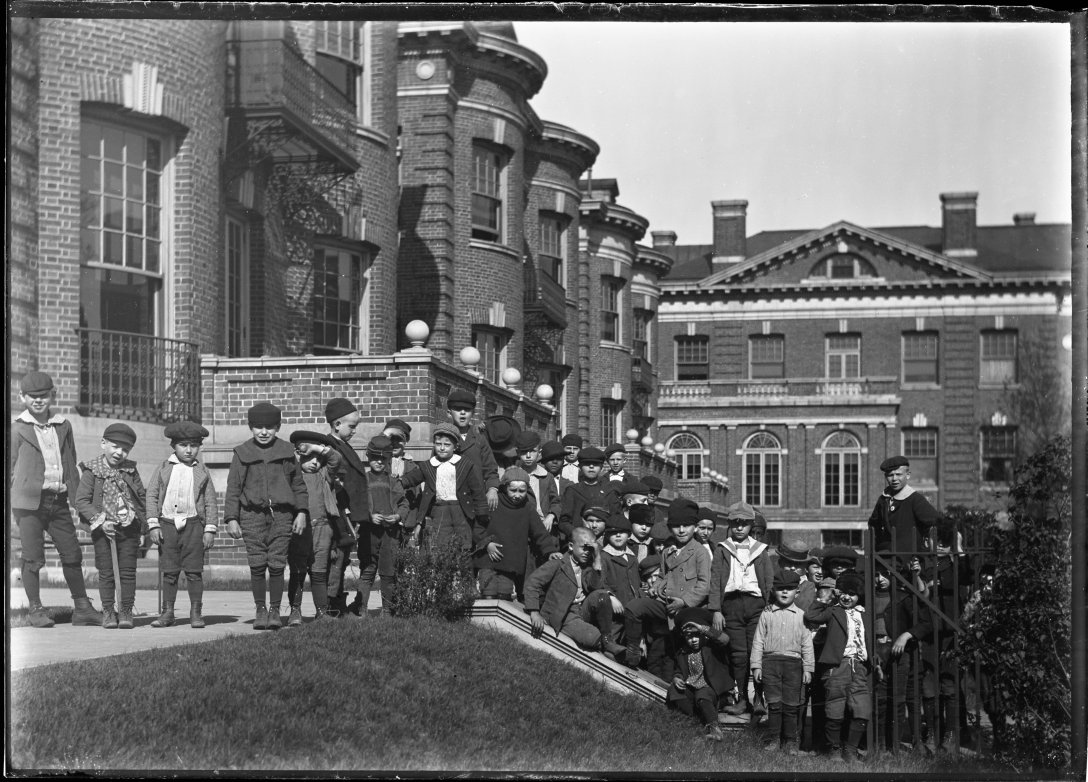
The Chicago Orphan Asylum was formed on 3 August 1849 as a response to the death and displacement caused by the worldwide cholera epidemic.[1] The Orphan Asylum was organized by a group of leaders in Chicago who were predominantly Protestant and early settlers of the city, including William B. Ogden, Orrington Lunt, Walter S. Newberry, William H. Brown, John H. Kinzie, and J. Young Scammon.[2] Ogden was Chicago’s first mayor and Newberry later became mayor of the city. Daily operations were managed by a board of women called the Board of Directresses.[3]
The official incorporation date of the Chicago Orphan Asylum was 5 November 1849.[4] The mission adopted in its incorporation was “the protecting, relieving, educating of, and providing means of support and maintenance for orphan and destitute children.”[5] According to author Mrs. Sarah Wheeler, “it was determined that no child should be bound out to service under ten years of age, but could be adopted at any time. It also permitted children of soldiers in the army, or who had been in the service of the United States, to have home in the asylum.”[6]
The first three children were admitted to the asylum on 11 September 1849.[7] The first home that the Orphan Asylum operated out of was originally in the house of Mrs. Ruth Hanson, the first Matron of the Orphan Asylum, which was situated on Michigan Avenue between Lake and Water Streets. [8] However, after a few months of fundraising, the asylum moved to Adams Street, between State and Dearborn Street, into a frame house.[9]
A short time later, the asylum moved to the Hinton House on Wells Street [Fifth Avenue], between Van Buren and Harrison Streets.[10]
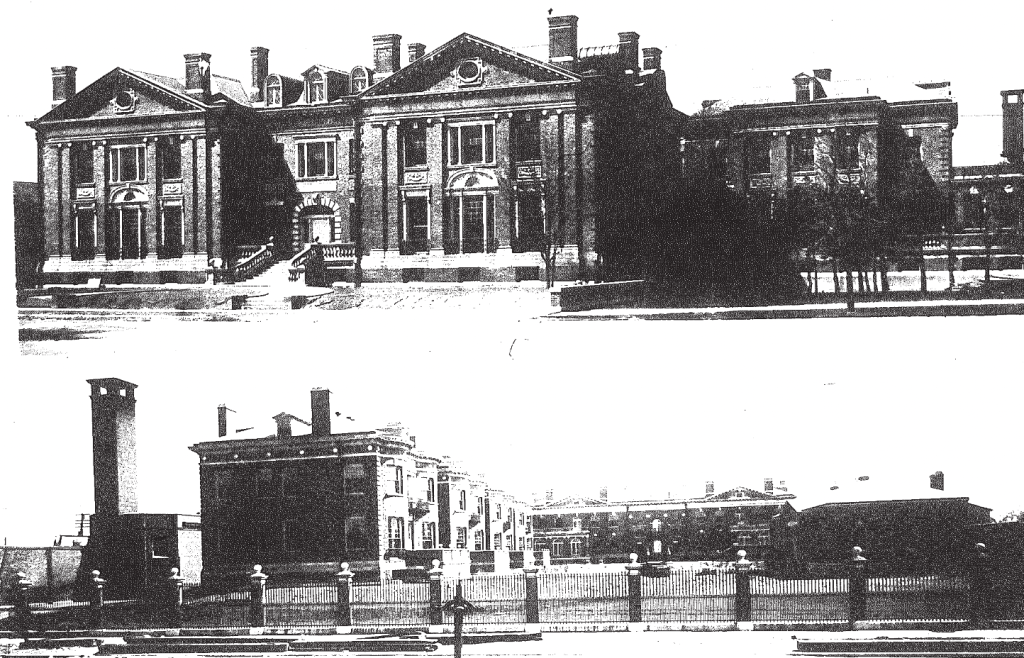
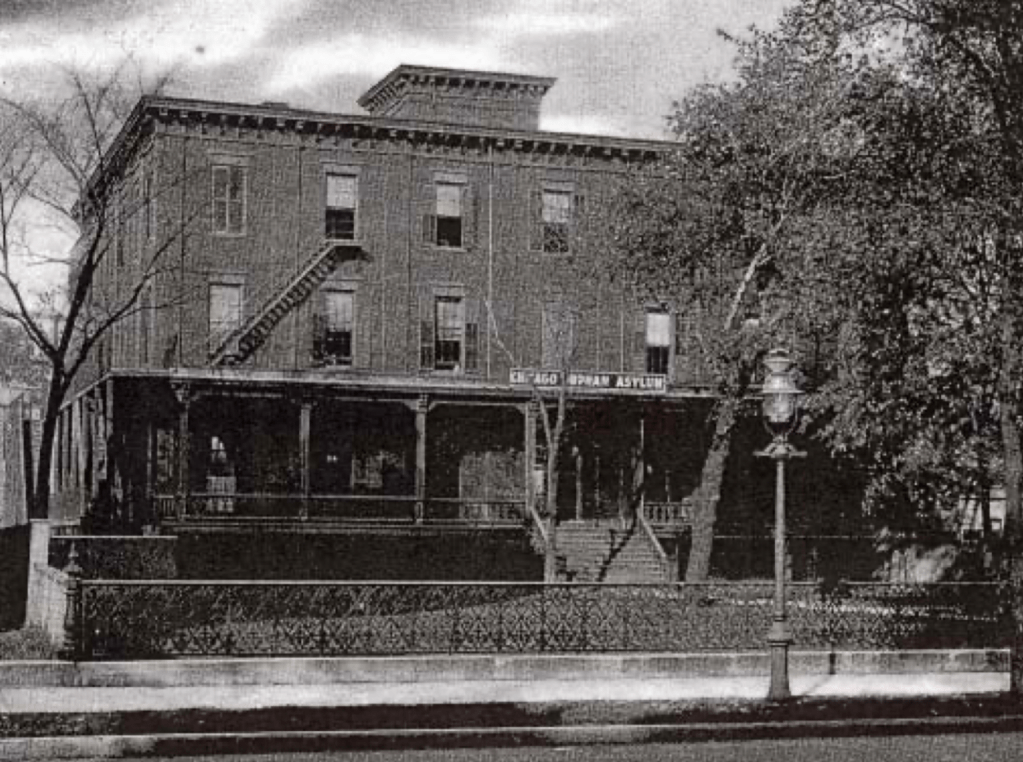
Around 1850, Mr. Johnson donated a lot of land on the north side of the river to erect a permanent building and the Orphan Asylum expanded the size of the campus by buying the surrounding land.[11] The orphanage moved in 1853 to this site, 2228 South Michigan Avenue, into a three-story brick building designed by Burling and Baumann.[12] The building was enlarged in 1884 with the addition of Talcott Hall.[13]
After the Great Chicago Fire, in October 1871, the Chicago Orphan Asylum opened its doors to assist men, women, and children. A depot for clothing distribution under the auspices of the Chicago Relief and Aid Society was set up in the parlors of the asylum and a temporary sewing room was created in a school-room for the use of a sewing society for the employment of women who lost their jobs due to the fire.[14]
The addition of Talcott Hall in 1884 included an addition to the school room and increased accommodations to a capacity of 250 children.[15] The Chicago Orphan Asylum included a school since before 1877.[16] However, as more children were admitted, it became necessary to re-organize the school and model it after the public schools in Chicago. So, secondary and primary departments were created.[17] In 1882, a primary department and kindergarten was established, which opened with an attendance of 40 children from five to seven years old.[18] In December 1883, a kindergarten opened, and it was presided over by teachers connected to the Free Kindergarten Association.[19]
In 1887, the Board of Directresses decided that all children who could pass the required exams for the third grade would be sent to the Chicago public schools.[20] Several students were able to pass and were transferred to the Mosely School and the Chicago Manuel Training School took one of the boys from the orphanage as well.[21]
Around 1891, the Chicago Orphan Asylum was maintaining three schools, with an average attendance 150 students.[22] By 1892, the School Committee of the Board of Trustees decided that all children over seven years old were to attend the public schools.[23] Upon this decision, the school departments of the orphanage were organized into one department: Kindergarten Primary.[24]
The Chicago Orphan Asylum also ran an industrial school. In 1874, a sewing school was established in the orphanage by the Directresses of the Board of Trustees for the education of both boys and girls.[25] The sewing school was later changed into an industrial school, which included sewing for the girls and the employment of a printer to teach typesetting for the boys.[26] In March 1890, it was decided to modify the plans for the industrial school, as many of the older children were attending the public schools and unable to be present at the regular class times.[27] Thus, shortly after, the Industrial School within the orphanage was closed.
On 18 November 1879, Former President Ulysses S. Grant visited the Orphan Asylum and met with the children.[28]
In 1899, the Chicago Orphan Asylum moved to 5120 South King Drive. At the time, the street was named “South Park Avenue,” but it was later renamed after Dr. Martin Luther King Jr. This building was designed by the architects at Shepley, Rutan, and Coolidge, who also designed the Allerton Wing of The Art Institute of Chicago and the original Chicago Public Library.
By the 1920s, due to changes in child-care practices and social welfare, the Chicago Orphan Asylum changed its mission from large-scale institutional, residential care for children to smaller-scale living arrangements. The Orphan Asylum moved its remaining children to a smaller rented building at 4911 South King Drive (then South Park Avenue), which has since been demolished.[29] By 1938, the Chicago Orphan Asylum began a foster care service.[30] By its 100th anniversary in 1949, the Chicago Orphan Asylum was no longer an “asylum,” as it had changed it “adopted a plan for providing foster home care for babies and children up to 6 years old.”[31]
After moving out of 5120 South King Drive, the Orphan Asylum sold the building in 1940 to the Good Shepherd Community Center, which became a significant institutional anchor in the Bronzeville community and was strongly associated with the literary and artistic movement of the 1930s and 40s known as the “Chicago Black Renaissance.” In 1957, the Chicago Baptist Institute purchased the building.[32]
The Orphan Asylum continued operating through adoption and foster care work. In 1949 it changed its name to the Chicago Child Care Society (CCCS) and later CCCS merged with Family Focus.
Institution Name and Type
Alternative Names: Chicago Protestant Orphan Asylum[33]
Type of Institution: Agency, Foster Care, Industrial School, Orphanage
The industrial school was closed shortly after 1890 (see overview for details).
By 1938, the Chicago Orphan Asylum began a foster care service.[34]
In the later years of the twentieth century, the Chicago Orphan Asylum became more focused on adoption placement, foster care, and education.
Location and Building
Address:
1849: Michigan Avenue between Lake and Water Streets, frame house
1849: Adams Street, between State and Dearborn Street, frame house
1849-1850: Hinton House on Wells Street [Fifth Avenue], between Van Buren and Harrison Streets
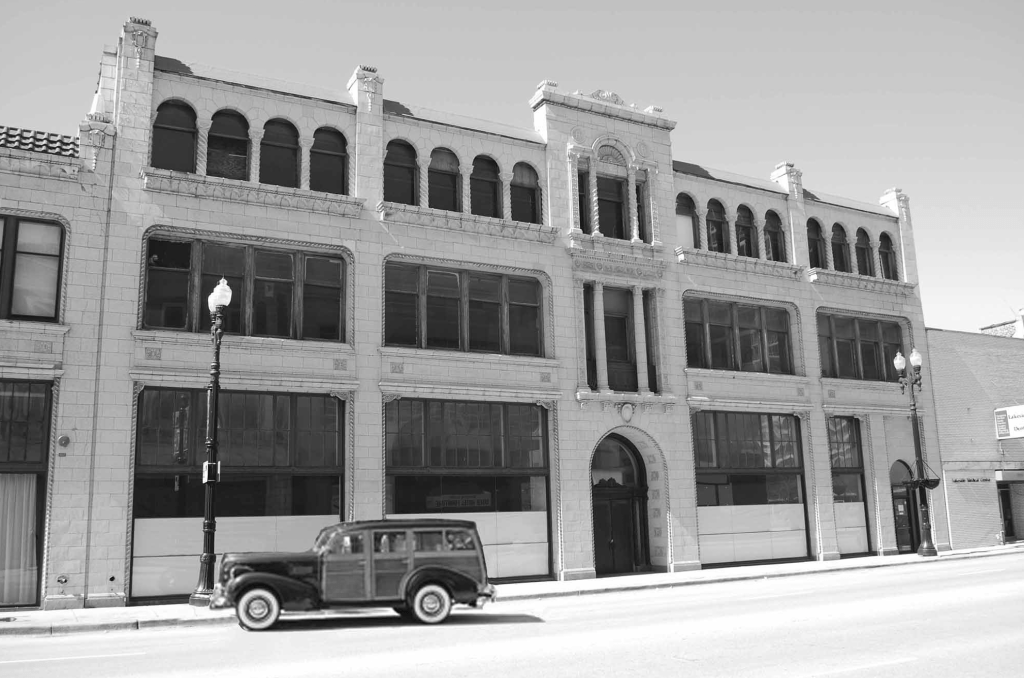
Notes on the buildings: The building at 2228 South Michigan Avenue that housed the Chicago Orphan Asylum from 1853 to 1899 was sold by the Orphan Asylum in 1899.[40] The building was torn down in the early 1920s to make room for the Marmon and Hudson Automobile Showrooms, which are now contributing to the Motor Row Chicago Landmark District.[41] The building at 5120 South King Drive still stands and is occupied by the Chicago Baptist Institute.
Administration Information
Date of Founding: 1849
Dates of Name, Place, Mission Change, or Merger:
After March 1890: The industrial school was closed as more children attended the public schools
By 1930, the Chicago Orphan Asylum began a foster care service and by 1942 was no longer a residential institution..[42][43]
1949: changed name to Chicago Child Care Society
Successor: Chicago Child Care Society
Date of Overall Closure: Not applicable. Chicago Child Care Society merged with Family Focus in 2001 and still operates today.
Administration:
1910: Private corporation
1923: Protestant churches
Contributors/Support:
Endowments, Tolcott Fund, Private contributions
The Froebel Association assumed the expenses of the school after 1883.[44]
October 1871- April 1872: the asylum received $400 a month from the A. T. Stewart Relief Fund to provide for the “maintenance of children whose widowed mothers were dependent upon themselves for support.”[46]
April 1872: $10,000 from the Executive Committee of the Chicago Relief and Aid Society.[47]
After 1881: Mrs. Mary H. Talcott, donated over $5,500.[48]
1892: “No age, race or condition have ever been turned unassisted away.”[63]
1892: “But of late years admission was confined to children from one to twelve years of age.”[64]
1910: Male max age 10, Female max age 12
1923: 1-12 years
1949: plan adopted to provide foster care for babies and children up to 6 years old, but in practice provided foster care for babies through 17 year olds.[65]
Intake Ethnicity/Race:
1892: “No age, race or condition have ever been turned unassisted away.”[66]
1904: “There is no race or color distinction with the children. Almost every nationality is represented among them.”[67]
1910: All
1923: White, Chinese, Japanese
Intake Specifics:
1872: “It was also determined to receive from the Courts vagrant and homeless children who were in no wise subjects for penal institutions, yet for whom no other places were provided. These were mostly children sent out by Eastern institutions and run-aways from home.”[68]
Before 1892: “Many little ones have but one parent who cannot always provide a home for them, and so this asylum receives them to its homelike care, for which a small amount is paid each week. Here, again, we experience the wisdom of that kindly heart Judge Thomas, who years ago, when the project was first inaugurated, introduced the word ‘destitute’ in to the Constitution. He is not the only orphaned one whose parents sleep ‘life’s dreamless sleep.’ There is a deeper orphanhood than that, when father forgets his trust and fails to provide, and mother turns from her clinging offspring, while her heart gives no response to its helpless cry. Frequently these are as evidently cases for the reception of the charity of this institution as orphans themselves.”[69]
1892: “No age, race or condition have ever been turned unassisted away.”[70]
1892: Small amount paid for the board of children who parents place them temporarily in the asylum—regular price is $1.50 a week for each child.[71]
1910: Orphan
1949: Orphans, children under the jurisdiction of the juvenile court[72]
Number of Residents:
1849-1850: 100 children were sheltered in the asylum over the first two years.[73]
“Of these was a mute, whose silent language reached the soul with an appeal which could but awaken the tenderest sympathy.”[75]
Between 1874 and 1892: over 3,680 children were admitted and 3,237 children were removed.[76]
1882: 40 children between 5-7 years old were educated in the primary school.[77]
1891-1892: 203 children, 170 were removed by their parents or friends, 10 adopted, 13 died.[78]
1892, September: 135 children from the orphanage entered public school.[79]
1922: 162 children in the home in November 1922, 255 cared for during the year.[80]
1949: more than 530 children cared for in foster homes by the Chicago Orphan Asylum.[81]
Records
“The number of children admitted to the asylum increases with every year. It became advisable for the reception committee, before whom persons came for admission, to keep an exact record of every child coming before them, its name and age, and name and nationality of parent or guardian. This plan has been faithfully carried out, and has been of great advantage in preventing imposition, and systematizing the work.”[82]
Wheeler, (Mrs.) Charles Gilbert [identified as Sarah Jenkins Wheeler]. 1892. Annals of the Chicago Orphan Asylum from 1849 to 1892. Chicago: Board of the Chicago Orphan Asylum. https://archive.org/details/annalsofchicagoo00whee.
Board of State Commissioners of Public Charities. 1880. Sixth Biennial Report of the Board of State Commissioners of Public Charities of the State of Illinois, November 1880. Springfield, Illinois: H. W. Rokker, State Printer and Binder. https://www.google.com/books/edition/_/OobIAAAAMAAJ.
—. 1884. Eighth Biennial Report of the Board State Commissioners of Public Charities of the State of Illinois, November 1884. Springfield, Illinois: H. W. Rokker, State Printer and Binder. https://www.google.com/books/edition/_/DKTIAAAAMAAJ.
Illinois State Charities Commission. 1911. Second Annual Report of the State Charities Commission to the Honorable Charles S. Deneen, Governor of Illinois. Springfield, Illinois: Illinois State Journal Company. https://www.google.com/books/edition/Annual_Report/pFgZAQAAIAAJ.
—. 1927. Children Under Institutional Care, 1923: Statistics of Dependent, Neglected, and Delinquent Children in Institutions and Under the Supervision of Other Agencies for the Care of Children, with a Section on Adults in Certain Types of Institutions. Washington, D.C.: Governmental Printing Office. https://play.google.com/store/books/details?id=PFXZTGK-ZyAC&rdid=book-PFXZTGK-ZyAC&rdot=1.
Wheeler, (Mrs.) Charles Gilbert [identified as Sarah Jenkins Wheeler]. 1892. Annals of the Chicago Orphan Asylum from 1849 to 1892. Chicago: Board of the Chicago Orphan Asylum. https://archive.org/details/annalsofchicagoo00whee.
[1] Chicago Department of Zoning and Land Use Planning. 2008. “Landmark Designation Report: Chicago Orphan Asylum Building, 5120 S. King Dr.” Chicago: City of Chicago. 2.
[2] Chicago Department of Zoning and Land Use Planning, 2008. 2.
[3] Chicago Department of Zoning and Land Use Planning, 2008. 2.
[29] Chicago Department of Zoning and Land Use Planning, 2008. 22.
[30] Meinzer, Helen S. 1938. “Sources and Methods of Seeking Foster Homes Used by Seven Child Placing Agencies.” Child Welfare League of America Bulletin 23 (9): 1-9.
[31] “Orphan Asylum Group to Mark 100 Years’ Care.” Chicago Tribune (24 October 1949), p. 29, col. 3-6.
[32] Chicago Department of Zoning and Land Use Planning, 2008. 1, 5.
[33]Chicago: An Instructive and Entertaining History of a Wonderful City. With a Useful Stranger’s Guide. 1888. Chicago: Rhodes & McClure Publishing Co. 222.
The Anna Brown Home for the Aged was originally erected as a private residence in 1875 by Anna Brown, widow of Charles Brown. She built a three-story brick house and lived there until her death in 1893. In her will, she provided for the establishment of a home for the aged, to which she gave her home at Fifth and Maple streets in Quincy (1501 North Fifth Street), and endowed it with $55,000. The home opened in January 1898.
Institution Name
Alternative Names: Anna Brown Home
Type of Institution: Aged
Location and Building
Street Address: 1501 North Fifth St.
Locality: Quincy
County: Adams
State: Illinois
Alternative Address: Fifth and Maple
Notes on the building (does it still exist?): No, the building was demolished in 2012 after a fire destroyed much of the structure.
Administration Information
Date of Founding: January 1898
Date of Name, Place, or Mission Change, or Merger: 1970[1]
Date of Overall Closure: after 1970
Dates of Operation at This Address Under This Name with the Same Mission: 1868-1970
Notes: The Anna Brown Home merged with Good Samaritan Home on September 1, 1970.[2] It was later owned by a series of developers who operated it as apartments until it was left vacant when it deteriorated.
Administration: Board of Trustees
Contributors/Support:
Notable People
Anna E. Brown: Provided in her will for the establishment of a home for the aged—provided her residence for such a home.[3]
The Adams County Almshouse was in operation from 1858 through 1860. In 1875, a new building in Gilmer Township, Adams County, was completed.
Institution Name
Alternative Names: Adams County Poor Farm
Type of Institution: Almshouse
Location and Building
Locality: Paloma
County: Adams County
State: Illinois
Notes on the building:
July 29, 1915: “The architecture of the main building belongs to the period when almshouses were designed to appear as gloomy and as desolate as possible. The building is three stories in height. The straight, high walls are unrelieved by balconies or verandas, except at the ends. The entire width of the building presents like an expanse of many windows set close together and suggests the many cell-like rooms within.”[1]
Administration Information
Date of Founding: 1858
Date of Name, Place, or Mission Change, or Merger: 1875
Date of Overall Closure: 1960
Dates of Operation at This Address Under This Name with the Same Mission: 1875-1960
Original Name at Founding if Changes Occurred: Adams County Almshouse
Notes: A poor farm was in operation in Adams County since at least 1858. By 1875, construction of a new Almshouse was completed in Gilmer Township, Adams County.
Administration: Adams County
Notable People
William Elliott: Keeper of the Almshouse circa 1880.[2]
J. E. Earl: Superintendent of the Almshouse circa 1906-1908.[3]
J. R. Pearce: Superintendent of the Almshouse circa 1906-1909.[4]
John Swank: Superintendent of the Almshouse circa 1910-1918.[5][6]
Intake Information and Requirements
Intake Gender/Sex: 1915: Female, Female
Intake Age: All ages.
Intake Specifics:
1880: 36 insane paupers upon the farm, 25 of whom were in seclusion.[7]
1884: 115 inmates–“43 were insane, 2 idiots, 1 deaf, and 3 blind. 8 were children under 16 years of age… The county endeavors to find homes for children believing that the poorhouse is not the proper place for them. Neither is it the proper place for the insane. All the insane inmates have been committed by a verdict of the court.”[8]
July 29, 1915:
The rooms on the second floor have barred doors which were used when these rooms were occupied by insane inmates.[9]
1880: “In our last report, mention was made of one female patient who occupies a large wooden box filled with straw. She will not wear clothing, but is covered with a canvass cloth, is in constant motion, has bruised herself from head to foot, and put out her own eyes. This patient is still an occupant of the box referred to, and now has for company, in the same room, another female patient, not in a box, but in an entirely nude condition.”[13]
Board of State Commissioners of Public Charities. 1880. Sixth Biennial Report of the Board of State Commissioners of Public Charities of the State of Illinois, November 1880. Springfield, Illinois: H. W. Rokker, State Printer and Binder. https://www.google.com/books/edition/_/OobIAAAAMAAJ.
—. 1884. Eighth Biennial Report of the Board State Commissioners of Public Charities of the State of Illinois, November 1884. Springfield, Illinois: H. W. Rokker, State Printer and Binder. https://www.google.com/books/edition/_/DKTIAAAAMAAJ.
—. 1909. Twentieth Biennial Report of the Board of State Commissioners of Public Charities of the State of Illinois: Being a Statistical Record of the Public Charity Service for the Period July 1, 1906 to June 30, 1908, and embracing Recommendations for the Period July 1, 1908 to June 30, 1910. Springfield, Illinois: Illinois State Journal Company. https://www.google.com/books/edition/Biennial_Report_of_the_Board_of_State_Co/RroWAAAAYAAJ.
State Charities Commission. 1911. Second Annual Report of the State Charities Commission to the Honorable Charles S. Deneen, Governor of Illinois. Springfield, Illinois: Illinois State Journal Company. https://www.google.com/books/edition/Annual_Report/pFgZAQAAIAAJ.
The Institution Quarterly: An Official Organ of the Public Charity Service of Illinois. 1916.Volume VII. Springfield, Illinois: State Board of Administration, State Charities Commission, and State Psychopathic Institute. https://www.google.com/books/edition/Welfare_Bulletin/qa5CAQAAIAAJ.
[1]The Institution Quarterly: An Official Organ of the Public Charity Service of Illinois. 1916.Volume VII. Springfield, Illinois: State Board of Administration, State Charities Commission, and State Psychopathic Institute. https://www.google.com/books/edition/Welfare_Bulletin/qa5CAQAAIAAJ.
[2] Board of State Commissioners of Public Charities. 1880. Sixth Biennial Report of the Board of State Commissioners of Public Charities of the State of Illinois, November 1880. Springfield, Illinois: H. W. Rokker, State Printer and Binder. https://www.google.com/books/edition/_/OobIAAAAMAAJ.
[3] Board of State Commissioners of Public Charities. 1909. Twentieth Biennial Report of the Board of State Commissioners of Public Charities of the State of Illinois: Being a Statistical Record of the Public Charity Service for the Period July 1, 1906 to June 30, 1908, and embracing Recommendations for the Period July 1, 1908 to June 30, 1910. Springfield, Illinois: Illinois State Journal Company. https://www.google.com/books/edition/Biennial_Report_of_the_Board_of_State_Co/RroWAAAAYAAJ.
[4] Board of State Commissioners of Public Charities. 1909. Twentieth Biennial Report of the Board of State Commissioners of Public Charities of the State of Illinois: Being a Statistical Record of the Public Charity Service for the Period July 1, 1906 to June 30, 1908, and embracing Recommendations for the Period July 1, 1908 to June 30, 1910. Springfield, Illinois: Illinois State Journal Company. https://www.google.com/books/edition/Biennial_Report_of_the_Board_of_State_Co/RroWAAAAYAAJ.
[5] State Charities Commission. 1911. Second Annual Report of the State Charities Commission to the Honorable Charles S. Deneen, Governor of Illinois. Springfield, Illinois: Illinois State Journal Company. https://www.google.com/books/edition/Annual_Report/pFgZAQAAIAAJ.
[7] Board of State Commissioners of Public Charities. 1880. Sixth Biennial Report of the Board of State Commissioners of Public Charities of the State of Illinois, November 1880. Springfield, Illinois: H. W. Rokker, State Printer and Binder. https://www.google.com/books/edition/_/OobIAAAAMAAJ.
[8] 1884. Eighth Biennial Report of the Board State Commissioners of Public Charities of the State of Illinois, November 1884. Springfield, Illinois: H. W. Rokker, State Printer and Binder. https://www.google.com/books/edition/_/DKTIAAAAMAAJ.
[9]The Institution Quarterly: An Official Organ of the Public Charity Service of Illinois. 1916.Volume VII. Springfield, Illinois: State Board of Administration, State Charities Commission, and State Psychopathic Institute. https://www.google.com/books/edition/Welfare_Bulletin/qa5CAQAAIAAJ.
[10] Board of State Commissioners of Public Charities. 1880. Sixth Biennial Report of the Board of State Commissioners of Public Charities of the State of Illinois, November 1880. Springfield, Illinois: H. W. Rokker, State Printer and Binder. https://www.google.com/books/edition/_/OobIAAAAMAAJ.
[11] 1884. Eighth Biennial Report of the Board State Commissioners of Public Charities of the State of Illinois, November 1884. Springfield, Illinois: H. W. Rokker, State Printer and Binder. https://www.google.com/books/edition/_/DKTIAAAAMAAJ.
[13] Board of State Commissioners of Public Charities. 1880. Sixth Biennial Report of the Board of State Commissioners of Public Charities of the State of Illinois, November 1880. Springfield, Illinois: H. W. Rokker, State Printer and Binder. https://www.google.com/books/edition/_/OobIAAAAMAAJ.
The orphanage was built in 1873 due to a newspaper error following the 1872 Lutheran Church-Missouri Synod convention in St. Louis.[1] A newspaper mistakenly mentioned that the Lutheran Church had planned to build an orphanage at the convention. While this was untrue, the church leaders decided that this was a good idea and launched plans to build one.[2] The church bought 38 acres at 343 West Lake Street in Addison, DuPage County, Illinois, and started the construction. The first building was meant to house 50 residents, but was later expanded in 1875, 1878, 1890, 1897, and 1922.[3] The architect Frederick Alschlager designed the 1897 addition to the building.[4]
In its early years, most orphans and residents stayed at the German Evangelical Lutheran Orphan Asylum (also known as the German Lutheran Orphan Asylum) until they were 14, then were sent to live with families in the area to learn farming and other trades until they were 18 years old.[5]
Next door to the orphanage was the Evangelical Lutheran Teachers Seminary. In 1913, the seminary moved to River Forest and the building was converted to house the Kinderheim Association (see Kinderheim for details).[6] Kinderheim was also run by the Lutheran church as a training and industrial school for children going through the court system. The building was razed in 1924 and a new structure was constructed to house up to 300 children in 1925.[7]
In 1940, Kinderheim and the orphanage were combined into one organization. The building that housed the German Evangelical Lutheran Orphan Asylum was demolished in 1959 and replaced by Lutherbrook. The original Kinderheim building served as an orphanage and campus for the organization until 1960. From 1961 to 2000 it was Addison’s Village Hall, after which it was demolished and replaced.[8] A historical marker nearby stands in its memory, created out of the original doorframe, windowsills, and brick of the building.[9] The marker includes plaques for the combined Kinderheim orphanage and the Lutheran Teacher’s Seminary.
The German Evangelical-Lutheran Orphan Home Association of Northern Illinois held an annual picnic in Addison, which was very popular. The picnic was known as the “Kinderheim Picnic” and the “Orphan Home Picnic.” The event also included a tour of the German Evangelical-Lutheran Orphan Home Association of Northern Illinois. “It was so popular that in 1890, five of Addison’s citizens formed the Addison Railroad Company and made an agreement with the Illinois Central Railroad to maintain the short two-mile line connecting Addison to the Illinois Central Railroad that came out of Chicago.”[10] The very first train came to Addison for the Orphan Home Picnic on 21 September 1890. After the festive outing that day, the thousands of children and adults began to board trains back to Chicago around 5pm. Around 7pm, the east bound train was standing at the Kedzie Avenue crossing on the Chicago, Burlington & Quincy railroad tracks, just a few feet from the Douglas Park station when a Chicago, Burlington & Quincy—Downer’s Grove express train crashed into the rear car of the picnic train.[11] Seven people died and at least eleven were seriously injured. For more information on this event that involved the Orphan Home Picnic, Barry A. Fleig’s Chicago and Cook County Cemeteries’ article “Children’s Picnic – then Horror” is recommended.
Institution Name
Alternative Names:
German Evangelical Lutheran Orphans’ Home Association
German Lutheran Orphan Asylum
Evangelical Lutheran Orphan Home
Evangelisch-lutherisches Waisenhaus
Type of Institution: Orphanage
Location and Building
Street Address: 343 W. Lake St.
Locality: Addison
County: DuPage County
State: Illinois
Notes on the building (does it still exist?): Demolished in 1959
Administration Information
Date of Founding: 1873
Date of Name, Place, or Mission Change, or Merger: 1934, 1940
Date of Overall Closure: 1940
Dates of Operation at This Address Under This Name with the Same Mission: 1873-1940
After Change See: Lutheran Child Welfare Association
Successor: Lutheran Child Welfare Association
Related To: Lutheran Orphans’ Home (Peoria), Kinderheim (Addison Manual Training School for Boys and Industrial School for Girls).
Notes: In 1934, the orphan home was merged with the Lutheran Children’s Friend Society in Peoria. In 1940, the orphanage merged with Kinderheim (Addison Manual Training School for Boys and Industrial School for Girls).
Administration:
1910: German Evangelical Orphan Society, Private corporation (Lutheran)
1923: Evangelical Lutheran Church
German Evangelical Lutheran Orphanage Association of North Illinois
Orphan Home Association
Contributors/Support: Various congregations of Missouri Synod Lutheran Churches.
Illinois Department of Visitation of Children Placed in Family Homes. 1912. Sixth Annual Report of the Department Visitation of Children Placed in Family Homes, Board of Administration of the State of Illinois, For the Year Ending December 31, 1911. Springfield, Illinois: Illinois State Journal Co. https://www.google.com/books/edition/Report_for_of_the_Department_Visitation/e1I9AQAAMAAJ.
—. 1914. Seventh Annual Report of the Department Visitation of Children Placed in Family Homes, Board of Administration of the State of Illinois, For the Year Ending December 31, 1913. Springfield, Illinois: Illinois State Journal Co.
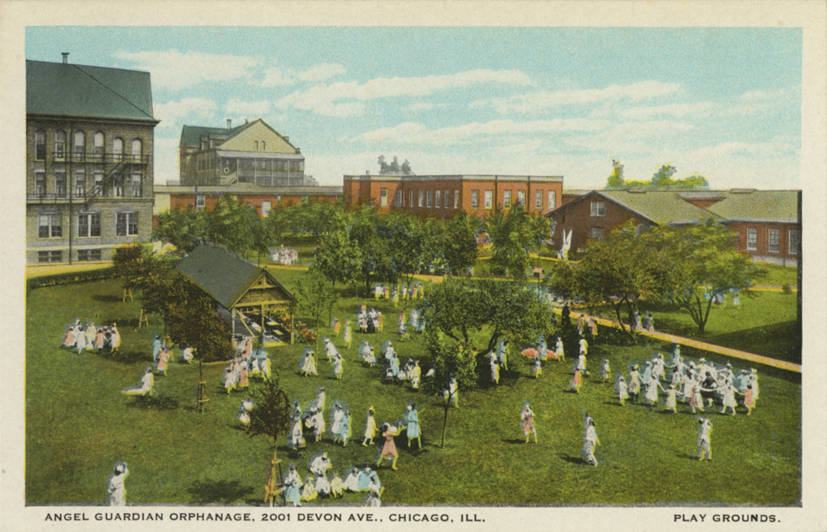
The Angel Guardian Orphanage was opened in 1865 in response to the increasing population of German Catholic orphans needing care in Chicago. The mission was created by give German Roman Catholic parishes in Chicago, which included St. Joseph’s and St. Michael’s, under the leadership of Father Holzer.[1] Chicago Bishop James Duggan blessed the orphanage and assigned the management to the St. Boniface Cemetery Association.
The orphanage was located on a 40-acre campus near Devon and Ridge in West Ridge (Rogers Park), Chicago.
Initially, the Poor Handmaids of Jesus Christ were recruited from Germany to take charge of the facility. The land was purchased from Mr. and Mrs. Chauncey Trumble.
The orphanage went by many names throughout its history, first known as “German Roman Catholic Orphanage of the Holy Guardian Angels at Rose Hill near Chicago.” [2]
At the turn of the century, in response to the wider social welfare debate between institutionalization and home placement, the orphanage changed after 1916 to a “cottage system” in which small groups of children shared a single living quarters and dining facility. On the Angel Guardian Orphanage Alumni Website, past residents often mention their cabin numbers.
In 1973, the Illinois Department of Children and Family Services decided to be in favor of home placement over institutionalization and cut Angel Guardian’s subsidies. The orphanage ended its childcare program in 1974 and in 1975 the Misericordia Home for Special Children took over the site, subsequently renamed Misericordia Home North.
Alternative Names:
Angel Guardian Orphan Asylum
German Orphan Asylum
Angel Guardian German Orphanage
Angel Guardian School
Angel Guardian Catholic Orphan Asylum
Angel Guardian German Catholic Society
Catholic Orphan Asylum at Rosehill
Catholic Orphan Asylum in Rosehill
German Catholic Orphanage of the Holy Guardian Angels
Type of Institution: Orphanage
Location and Building
Street Address: 2001 W. Devon Ave.
Locality: Chicago
County: Cook
State: Illinois
Alternative Address: 6300 N. Ridge Ave.
Notes on the building (does it still exist?): On Monday, October 27, 1879, the original children’s residence and convent burned down.
In 1974, the Angel Guardian Orphanage was replaced by Misercordia. Today, most of the cottages are gone, Misericordia Heart of Mercy occupies the old grounds.
Administration Information
Date of Founding: 1865
Name, Place, or Mission Changes, or Mergers:
27 Oct 1879: The original children’s residence and convent burned down.
Date of Overall Closure: 1974
Dates of Operation at This Address Under This Name with the Same Mission: 1865-1974
Successor: Misercordia Heart of Mercy
Administration:
1865-: St. Boniface Cemetery Association
1910: Angel Guardian German Catholic Society
1923: Poor Handmaids of Jesus Christ
1800s-1900s: German Catholic Society
1900s: Catholic Charities of Chicago
Contributors/Support:
The first few years of operation included support from the Catholic Diocese of Chicago, St. Peter’s Parish, St. Michael’s Parish, St. Joseph’s Parish, St. Francis’ Parish, St. Boniface’s Parish, St. Vincent’s Roman Catholic Aid Society, St. Alphonsus’ Liebesbund, and St. John’s Society.
Notable People
Bishop James Duggan: Bishop of Chicago who approved the establishment of the orphanage.
Mr. and Mrs. Chauncey Trumble: Original landowners of the property who sold the land to the orphanage.
Mr. and Mrs. Traufler: Original caretakers of the orphanage.
St. Boniface Cemetery Association: Managers of the orphanage beginning in 1865. Leadership included: Rev. Ferdinand Kalvelage, Rev. Peter Zimmer, F. S. Vogt, Rev. Peter Fischer, Fr. Meinhard, Anton Schager, and Michael Birchler.
Henry Weishaupt, Mary Weishaupt, and Pauline Weishaupt: Three of the first residents of the orphanage.
Superiors of Angel Guardian
Sister M. Hyacinth: First Mother Superior at Angel Guardian.
Sister Mary Paschalis: “On Saturday, June 14, 1873, Sister Mary Paschalis arrived via carriage. Due to her extreme height and girth, she was known affectionately as the “Big Sister” to both the orphans and the produce merchants on South Water Street. Sister Mary Paschalis was beloved by the children, especially the older boys who often accompanied her into the city to sell and barter excess produce from the orphanage’s farm yield.” [3]
“The Superiors of Angel Guardian included Sister Hyacintha (1868-1885 except 1873), Sister Blanca (1873), Sister Radegundis (1886-1889), and Sister Bartholomea (1889-1984). Sister Mary Paschalis Hesper worked at the orphanage from Saturday, June 14, 1873 until Monday, September 15, 1919, when she died from the influenza epidemic. These women of intense spirit served as mentors to the children who resided at Angel Guardian Orphanage. Many would follow in their footsteps by joining the Poor Handmaids of Jesus Christ. Caroline Weishaupt died as a postulant. Johanna Hochherz would become the second Sr. Radegundis. Vivian Leonard would become the second Sister Paschalis.”[4]
Father A. J. Thiele: President of the orphanage’s Board of Directors after 1897.
Baptisms from 30 January 1881-21 March 1910 are found in Communions, Confirmations 1881-1912 at FamilySearch.org (starts at image 1 of 96) (Note: written in Latin)
The original record book that FamilySearch has on microfilm/digitized went from 1917-1947. It is likely that the Archdiocese of Chicago Archives and Records Center has the remaining years that are not digitized.
The original record book that FamilySearch has on microfilm/digitized went from 1916-1943. It is likely that the Archdiocese of Chicago Archives and Records Center has the remaining years that are not digitized.
Burial Records from 7 February 1881 to 16 October 1912 are found in Communions, Confirmations 1881-1912 at FamilySearch.org (Pages 90-115, starts at image 73 of 96) Note: written in Latin)
From 1865-1881 see St. Henry’s Church, Chicago
Repositories and Archives
Archdiocese of Chicago Archives and Records Center
Since Angel Guardian Orphanage was run by the Catholic Church, most of the institution’s records are kept by the Chicago Archdiocese in their Archives and Records Center.
The collection includes Correspondence, Historical records and ephemera, Legal documents, Administrative papers, the Constitution and By-Laws, Annual Reports, Newsletters, Visitors’ Logs, Damage reports, Press Releases, Promotional Kits, School Handbooks, Property Inventory Reports, Deeds/Titles/Property Documents, Architectural Drawings/Contracts/etc., Minutes, Newspapers and Clippings, Various Publications, School Records and Yearbooks, Financial Records, and additional Artifacts.
United States Bureau of the Census. 1913. Benevolent Institutions 1910. 1913. Washington, D. C.: Department of Commerce, Bureau of the Census. https://books.google.com/books?id=fmgGAQAAIAAJ.
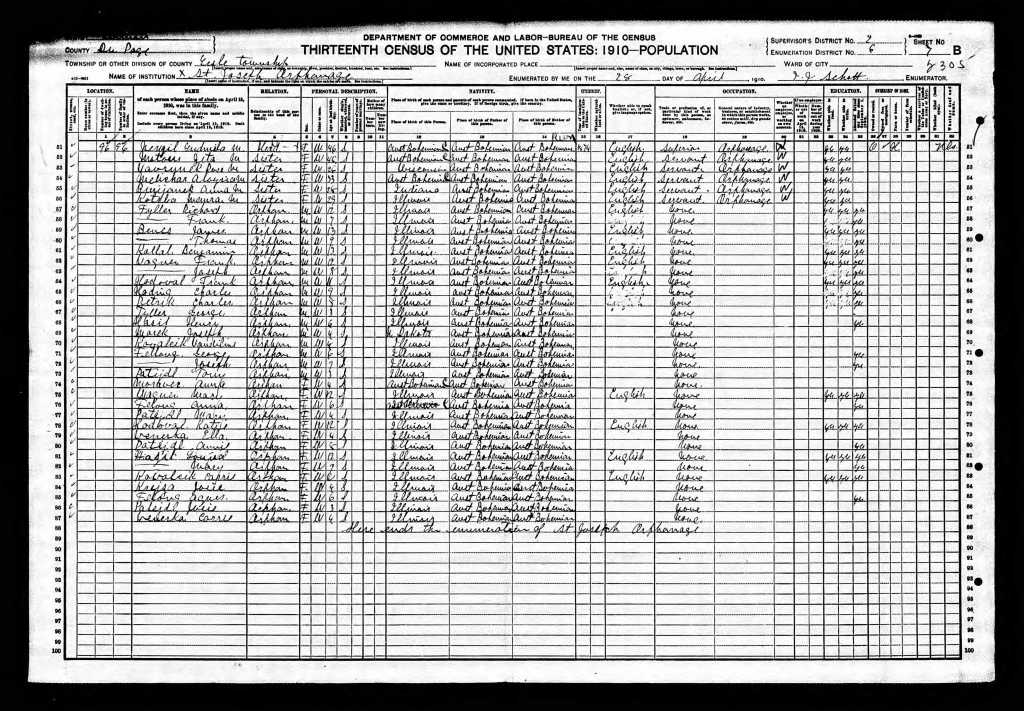
St. Joseph Bohemian Orphanage was established by Benedictine monks on November 15, 1898 in Lisle, DuPage County, Illinois.[1] Before this, the Polish and Bohemian orphans were house in St. Stanislaus Parish Orphanage in Chicago.[2] The Benedictine Fathers of St. Procopius Abbey donated several acres of land near Lisle, and the farm house, for an orphanage.[3]
The orphanage opened on March 18, 1898 with twelve children: six were Bohemian, three were Slovack, and three were Slovenian.[4] By 1910, the institution erected enough buildings to accommodate 150 children.[5]
On June 5, 1912, the institution was reincorporated as the Lisle Industrial School for Girls and the Lisle Manual Training School for Boys.[6] The children were under the care of the Bohemian Benedictine Sisters since its founding in 1898.[7]
In 1956, the orphanage closed and the building became a boy’s high school: St. Procopius Academy.[8] It is now Benet Academy.
Joseph’s Bohemian Orphanage
Alternative Names: Czech Orphanage
Type of Institution: Orphanage
Street Address: 2200 Maple Avenue
Locality: Lisle
County: DuPage
State: Illinois
Alternative Address: 1641 Allport Street, Chicago, Illinois
Note: This is the address of the administrative headquarters
Date of Founding: 15 Nov 1898
Date of Name, Place, or Mission Change, or Merger: 1912
Date of Overall Closure: 1956
Dates of Operation at This Address Under This Name with the Same Mission: 15 Nov 1898-1912
After Change See: Lisle Manual Training School for Boys and Lisle Manual Training School for Girls
Sister Mary Agatha Allison, “A Study of the Catholic Institutions for Dependent Children in the Archdiocese of Chicago Emphasizing Vocational Education,” Loyola University (1933).
[1] Sister Mary Agatha Allison, “A Study of the Catholic Institutions for Dependent Children in the Archdiocese of Chicago Emphasizing Vocational Education,” Loyola University (1933), 31.
[2] Sister Mary Agatha Allison, “A Study of the Catholic Institutions for Dependent Children in the Archdiocese of Chicago Emphasizing Vocational Education,” Loyola University (1933), 31.
[3] Sister Mary Agatha Allison, “A Study of the Catholic Institutions for Dependent Children in the Archdiocese of Chicago Emphasizing Vocational Education,” Loyola University (1933), 31.
[4] Sister Mary Agatha Allison, “A Study of the Catholic Institutions for Dependent Children in the Archdiocese of Chicago Emphasizing Vocational Education,” Loyola University (1933), 31.
[5] Sister Mary Agatha Allison, “A Study of the Catholic Institutions for Dependent Children in the Archdiocese of Chicago Emphasizing Vocational Education,” Loyola University (1933), 31.
[6] Sister Mary Agatha Allison, “A Study of the Catholic Institutions for Dependent Children in the Archdiocese of Chicago Emphasizing Vocational Education,” Loyola University (1933), 31.
[7] Sister Mary Agatha Allison, “A Study of the Catholic Institutions for Dependent Children in the Archdiocese of Chicago Emphasizing Vocational Education,” Loyola University (1933), 31.









 Institution Guide by Katharine Korte Andrew