Chicago-Winfield Tuberculosis Sanatorium

Overview

In 1897, Jessie P. Forsythe opened a family-run rest home on the property.[1] Forsythe sold the rest home in 1908 to Charles A. Stonchill who “presented it to the Jewish public, with the provision, however, that it be dedicated solely to the care of patients with tuberculosis.”[2] The announcement of his gift was made at a joint meeting of the Baron Hirsch Women’s Club and the Jewish Consumptive Relief Society, after which the two societies joined with the Willing Works and organized and incorporated the Chicago-Winfield Tuberculosis Sanitarium.[3] The sanitarium was non-sectarian.[4]

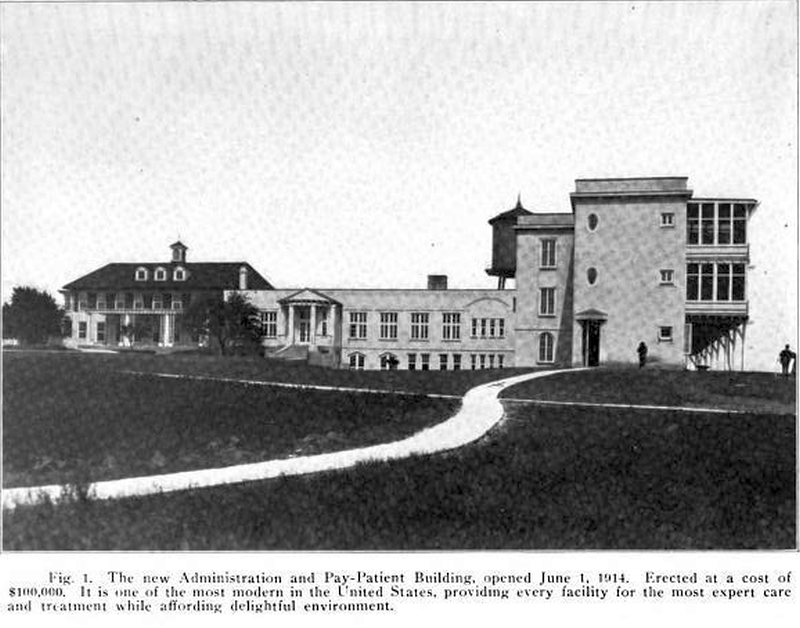
Initially, the sanitarium was a two-story frame building, however, in following decades, more land was acquired and a new sanitarium was constructed on the site.[5] By 1914, eight buildings were added to the sanitarium, including the administration building, children’s cottage, cottage for adult male patients, cottage for adult female patients, and a main building consisting of three stories and a wing for private pay patients.[6]

Patients that were able to pay were accepted, however, in 1914, “the majority of these patients are absolutely unable to pay anything, and, were it not for the generosity and humanitarianism of these broad-minded dispensers of charity, would be forced to continue to work as long as possible, until the disease was so far advanced that nothing could be done except to alleviate the suffering of the moment, until death claimed its victims.”[7]

In 1962, as more treatment for tuberculosis was being handled by places like Michael Reese Hospital in Chicago, the sanitarium closed and sold its property to citizens seeking to open a hospital in the area—that hospital became the Central DuPage Hospital.[8]

Institution Name and Type

Goal/Object

1914: “Primarily, the Chicago-Winfield Tuberculosis Sanatorium was organized for the care and treatment of patients in the curable stages of pulmonary tuberculosis, although now more advanced cases are admitted.”[9]

Type of Institution

Health : Hospital : Tuberculosis

Location and Building

Main Location

Address: 25 Winfield Rd

Locality: Winfield

County: DuPage

State: Illinois

Administration Information

Date of Founding

1909

Date of Total Closure

1962

Administration

1909: Private

1909: run by three societies—the Baron Hirsch Woman’s Club, the Jewish Consumption Relief Society, and the Willing Workers.[10]

Funding/Support

1914: support of the Associated Jewish Charities of Chicago and assistance of individual subscriptions[11]

Notable People

Administration

Dr. J. L. Anderson, Medical Director in 1914.[12]

Dr. J. C. Friedman, chairman of the advisory board in 1914.[13]

Flora M. Glenn, Chief Nurse prior to 1912.[14]

Dr. S. B. Hirshberg, Resident Physician and Superintendent.[15]

Dr. Theodore B. Sachs, Physician in Chief in 1911.[16]

Past Residents

Intake Information and Requirements

Intake Gender/Sex

Female, Male

Intake Age

All ages

Intake Specifics

1911: for incipient cases only[17]

Number of Residents

1911: capacity of 68 patients.[18]

1914: approximately 400 patients were cared for in the sanitarium each year with an average satay of three months.[19]

Records

It is unknown if there are surviving records relating to this hospital. It is recommended to contact the local historical societies and the charities that ran the institution.

Census Records

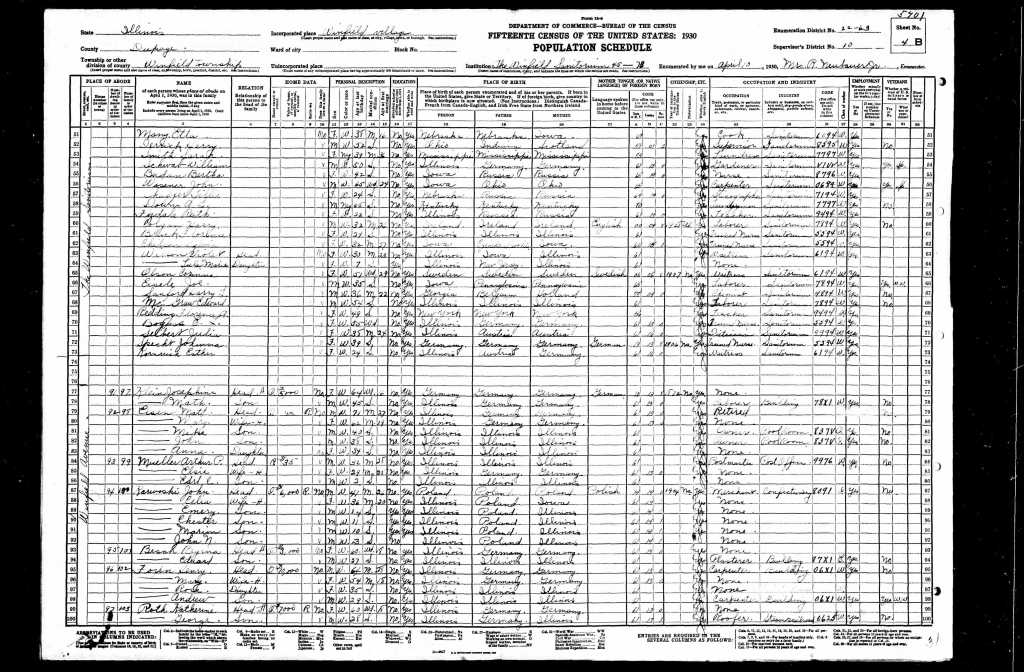
1930 U.S. Federal Census

1940 U.S. Federal Census

Sources

“Chicago-Winfield Tuberculosis Sanatorium.” 1914. The Chicago Medical Recorder 36(January-December 1914): 352-355.

Jacobs, Philip P. 1911. A Tuberculosis Directory. New York: The National Association for the Study and Prevention of Tuberculosis.

McCormac, Alice H. 1912. “School Nursing and School Work of the Visiting Nurses of Hartford, Conn.” The American Journal of Nursing 12(8): 659-663. https://www.jstor.org/stable/3404558.

“The Evolution of Winfield’s Rest Home.” 2021. Chicago Tribune. https://www.chicagotribune.com/1995/01/29/the-evolution-of-winfields-rest-home/.

“Two Hospitals, One Commitment.” n.d. Northwestern Medicine. Accessed on 25 July 2024. https://www.nm.org/about-us/history/northwestern-medicine-central-dupage-delnor-hospital-history.

Village of Winfield. n.d. “The History of Winfield, Illinois.” Winfield, Illinois: https://www.villageofwinfield.com/DocumentCenter/View/214/History-of-Winfield?bidId=.


[1] Village of Winfield. n.d. “The History of Winfield, Illinois.” Winfield, Illinois: https://www.villageofwinfield.com/DocumentCenter/View/214/History-of-Winfield?bidId=.

[2] “Chicago-Winfield Tuberculosis Sanatorium.” 1914. The Chicago Medical Recorder 36(January-December 1914): 352-355.

[3] “Chicago-Winfield Tuberculosis Sanatorium,” 1914. 352.

[4] “Chicago-Winfield Tuberculosis Sanatorium,” 1914. 352.

[5] “Two Hospitals, One Commitment.” n.d. Northwestern Medicine. Accessed on 25 July 2024. https://www.nm.org/about-us/history/northwestern-medicine-central-dupage-delnor-hospital-history.

[6] “Chicago-Winfield Tuberculosis Sanatorium,” 1914. 352.

[7] “Chicago-Winfield Tuberculosis Sanatorium,” 1914. 353.

[8] “Two Hospitals, One Commitment.” n.d. Northwestern Medicine. Accessed on 25 July 2024. https://www.nm.org/about-us/history/northwestern-medicine-central-dupage-delnor-hospital-history.

[9] “Chicago-Winfield Tuberculosis Sanatorium,” 1914. 353.

[10] “The Evolution of Winfield’s Rest Home.” 2021. Chicago Tribune. https://www.chicagotribune.com/1995/01/29/the-evolution-of-winfields-rest-home/.

[11] “Chicago-Winfield Tuberculosis Sanatorium,” 1914. 353.

[12] “Chicago-Winfield Tuberculosis Sanatorium,” 1914. 354.

[13] “Chicago-Winfield Tuberculosis Sanatorium,” 1914. 354.

[14] McCormac, Alice H. 1912. “School Nursing and School Work of the Visiting Nurses of Hartford, Conn.” The American Journal of Nursing 12(8): 662.

[15] Jacobs, 1911. 24.

[16] Jacobs, 1911. 24.

[17] Jacobs, 1911. 24.

[18] Jacobs, 1911. 24.

[19] “Chicago-Winfield Tuberculosis Sanatorium,” 1914. 353.

German Evangelical Lutheran Orphan Asylum, Addison, DuPage County

Overview

The orphanage was built in 1873 due to a newspaper error following the 1872 Lutheran Church-Missouri Synod convention in St. Louis.[1] A newspaper mistakenly mentioned that the Lutheran Church had planned to build an orphanage at the convention. While this was untrue, the church leaders decided that this was a good idea and launched plans to build one.[2] The church bought 38 acres at 343 West Lake Street in Addison, DuPage County, Illinois, and started the construction. The first building was meant to house 50 residents, but was later expanded in 1875, 1878, 1890, 1897, and 1922.[3] The architect Frederick Alschlager designed the 1897 addition to the building.[4]

In its early years, most orphans and residents stayed at the German Evangelical Lutheran Orphan Asylum (also known as the German Lutheran Orphan Asylum) until they were 14, then were sent to live with families in the area to learn farming and other trades until they were 18 years old.[5]

Next door to the orphanage was the Evangelical Lutheran Teachers Seminary. In 1913, the seminary moved to River Forest and the building was converted to house the Kinderheim Association (see Kinderheim for details).[6] Kinderheim was also run by the Lutheran church as a training and industrial school for children going through the court system. The building was razed in 1924 and a new structure was constructed to house up to 300 children in 1925.[7]

In 1940, Kinderheim and the orphanage were combined into one organization. The building that housed the German Evangelical Lutheran Orphan Asylum was demolished in 1959 and replaced by Lutherbrook. The original Kinderheim building served as an orphanage and campus for the organization until 1960. From 1961 to 2000 it was Addison’s Village Hall, after which it was demolished and replaced.[8] A historical marker nearby stands in its memory, created out of the original doorframe, windowsills, and brick of the building.[9] The marker includes plaques for the combined Kinderheim orphanage and the Lutheran Teacher’s Seminary.

The German Evangelical-Lutheran Orphan Home Association of Northern Illinois held an annual picnic in Addison, which was very popular. The picnic was known as the “Kinderheim Picnic” and the “Orphan Home Picnic.” The event also included a tour of the German Evangelical-Lutheran Orphan Home Association of Northern Illinois. “It was so popular that in 1890, five of Addison’s citizens formed the Addison Railroad Company and made an agreement with the Illinois Central Railroad to maintain the short two-mile line connecting Addison to the Illinois Central Railroad that came out of Chicago.”[10] The very first train came to Addison for the Orphan Home Picnic on 21 September 1890. After the festive outing that day, the thousands of children and adults began to board trains back to Chicago around 5pm. Around 7pm, the east bound train was standing at the Kedzie Avenue crossing on the Chicago, Burlington & Quincy railroad tracks, just a few feet from the Douglas Park station when a Chicago, Burlington & Quincy—Downer’s Grove express train crashed into the rear car of the picnic train.[11] Seven people died and at least eleven were seriously injured. For more information on this event that involved the Orphan Home Picnic, Barry A. Fleig’s Chicago and Cook County Cemeteries’ article “Children’s Picnic – then Horror” is recommended.

Institution Name

Alternative Names:

  • German Evangelical Lutheran Orphans’ Home Association
  • German Lutheran Orphan Asylum
  • Evangelical Lutheran Orphan Home
  • Evangelisch-lutherisches Waisenhaus

Type of Institution: Orphanage

Location and Building

Street Address: 343 W. Lake St.

Locality: Addison

County: DuPage County

State: Illinois

Notes on the building (does it still exist?): Demolished in 1959

Administration Information

Date of Founding: 1873

Date of Name, Place, or Mission Change, or Merger: 1934, 1940

Date of Overall Closure: 1940

Dates of Operation at This Address Under This Name with the Same Mission: 1873-1940

After Change See: Lutheran Child Welfare Association

Successor: Lutheran Child Welfare Association

Related To: Lutheran Orphans’ Home (Peoria), Kinderheim (Addison Manual Training School for Boys and Industrial School for Girls).

Notes: In 1934, the orphan home was merged with the Lutheran Children’s Friend Society in Peoria. In 1940, the orphanage merged with Kinderheim (Addison Manual Training School for Boys and Industrial School for Girls).

Administration:

  • 1910: German Evangelical Orphan Society, Private corporation (Lutheran)
  • 1923: Evangelical Lutheran Church
  • German Evangelical Lutheran Orphanage Association of North Illinois
  • Orphan Home Association

Contributors/Support: Various congregations of Missouri Synod Lutheran Churches.

Bequests from:

  • William Buschmann, died 1894, for $5,000.[12]
  • F. D. Scheibie, died 1904, for $500.[13]
  • Katharine Hahn, died 1906, for $200.[14]

Notable People

Rev. J. Grosse: President of the asylum in 1895.[15]

Rev. Theodore Thormahlen: Superintendent of the orphan home before 1940.[16]

Rev. Adolph Pfotenhauer: Superintendent of the Lutheran Orphanage at Addison.

Mr. Ernst Leubner: Superintendent or head of German Lutheran Orphans’ Asylum in Addison.[17]

Rev. H. Merz: Superintendent in 1915.

Mrs. H. Merz: Matron in 1915.

Rev. M. K. C. Vetter: Superintendent in 1925.

Past Residents:

  • Mrs. Pauline A. Kruse (abt. 1907-1999): raised in Lutheran Orphanage, Addison.[18]

Intake Information and Requirements

Intake Gender/Sex: Female, Male

Intake Age:

  • 1910: 2 to 10, but many older
  • 1915: up to 14 years
  • 1923: boys from 2-15 years, girls from 2-18 years

Intake Ethnicity/Race: 1923: White

Intake Religion: 1910: No restriction

Intake Specifics:

  • 1910: Orphan
  • 1915: Orphan and half-orphans, charges $1 per week per child. Capacity, 120.

Number of Residents:

  • 1895: 121 residents.[19]
  • Circa 1896: 166 residents.[20]
  • 1915: capacity at 120.

Records

Archives and Repositories

Addison Historical Museum

135 W. Army Trail Blvd., Addison, Illinois

630-628-1433

https://www.addisonadvantage.org/visitors/history_2/index.php

https://addisonhistory.pastperfectonline.com

Concordia Historical Institute

http://concordiahistoricalinstitute.org
804 Seminary Place
Saint Louis MO 63105 USA
314-505-7935
reference@concordiahistoricalinstitute.org

https://concordiahistoricalinstitute.libraryhost.com/repositories/2/archival_objects/3118.

Sources

City of Chicago, Department of Public Welfare. 1915. Social Service Directory. Chicago: City of Chicago. https://www.google.com/books/edition/Social_Service_Directory/1YgDAAAAMAAJ.

Fleig, Barry A. 2020. “Children’s Picnic – then Horror.” Chicago and Cook County Cemeteries: A Historical and Contemporary Resource. https://chicagoandcookcountycemeteries.com/2020/02/15/childrens-picnic-then-horror/

Huenink, James. 2021. “Chicago Lutheran History: The Lutheran Orphanage-1873,” Medium. https://hueninkwrites.medium.com/chicago-lutheran-history-the-lutheran-orphanage-1873-88c3475c5234.

Illinois Department of Public Welfare. 1927. Nineth Annual Report of the Department of Public Welfare, July 1, 1925 to June 30, 1926. Springfield, Illinois: Illinois State Journal Co. https://www.google.com/books/edition/Annual_Report/pmAbAQAAIAAJ.

Illinois Department of Visitation of Children Placed in Family Homes. 1912. Sixth Annual Report of the Department Visitation of Children Placed in Family Homes, Board of Administration of the State of Illinois, For the Year Ending December 31, 1911. Springfield, Illinois: Illinois State Journal Co. https://www.google.com/books/edition/Report_for_of_the_Department_Visitation/e1I9AQAAMAAJ.

—. 1914. Seventh Annual Report of the Department Visitation of Children Placed in Family Homes, Board of Administration of the State of Illinois, For the Year Ending December 31, 1913. Springfield, Illinois: Illinois State Journal Co.

“Kinderheim Arch,” HMdb.org. https://www.hmdb.org/m.asp?m=47431.

Lenker, John Nicholas. 1896. Lutherans in All Lands: The Wonderful Works of God. Milwaukee: Lutherans in All Lands Company. https://www.google.com/books/edition/Lutherans_in_All_Lands/6nMrAAAAYAAJ?hl=en&gbpv=0.

“Lutheran Homes at Addison to be Run as One,” Chicago Tribune, 18 August 1940, part 3, page 3, col. 1. Imaged at Newspapers.com.

“Newspaper error leads to home for orphans,” Chicago Tribune, 18 August 1940, Section 17, page 2, col. 2. Imaged at Newspapers.com.

“Site of Lutheran Teacher’s Seminary: 1864-1913.” HMdb.org. https://www.hmdb.org/m.asp?m=47436.

“The Story of US Orphanages: Illinois.” Former Children’s Homes. Accessed on 23 July 2022. http://www.formerchildrenshomes.org.uk/illinois.html.

United States Bureau of the Census. 1913. Benevolent Institutions 1910. Washington, D. C.: Governmental Printing Office. https://books.google.com/books?id=fmgGAQAAIAAJ.

—. 1927. Children Under Institutional Care, 1925. Washington, D. C.: Governmental Printing Office. https://play.google.com/store/books/details?id=PFXZTGK-ZyAC&rdid=book-PFXZTGK-ZyAC&rdot=1.

Wolf, Edmund Jacob. 1889. The Lutherans in America: A Story of Struggle, Progress, Influence and Marvelous Growth. New York: J. A. Hill & Company. https://www.google.com/books/edition/The_Lutherans_in_America/x0U3AAAAMAAJ.


[1] “Newspaper error leads to home for orphans,” Chicago Tribune, 18 August 1940, Section 17, page 2, col. 2. Imaged at Newspapers.com.

[2] Ibid.

[3] Ibid.

[4] “Frederick Alschlager has designed…,” The Chicago Chronicle, 8 September 1895, page 22, col. 4. Imaged at Newspapers.com.

[5] “Newspaper error leads to home for orphans,” Chicago Tribune, 18 August 1940, Section 17, page 2, col. 2. Imaged at Newspapers.com.

[6] “Site of Lutheran Teacher’s Seminary: 1864-1913.” HMdb.org. https://www.hmdb.org/m.asp?m=47436.

[7] “Newspaper error leads to home for orphans,” Chicago Tribune, 18 August 1940, Section 17, page 2, col. 2. Imaged at Newspapers.com.

[8] “Kinderheim Arch,” HMdb.org. https://www.hmdb.org/m.asp?m=47431.

[9] “Kinderheim Arch,” HMdb.org. https://www.hmdb.org/m.asp?m=47431.

[10] Fleig, Barry A. 2020. “Children’s Picnic – then Horror.” Chicago and Cook County Cemeteries: A Historical and Contemporary Resource. https://chicagoandcookcountycemeteries.com/2020/02/15/childrens-picnic-then-horror/

[11] “Dangers of Travel,” The Ogle County Press, 27 September 1890, page 6, col. 5. Imaged at Newspapers.com.

[12] “Court of Record,” The Inter Ocean (Chicago, Illinois), 9 May 1894, page 10, col. 1. Imaged at Newspapers.com.

[13] “German Lutherans Gain $1500,” The Dispatch (Moline, Illinois), 19 October 1904, page 4, col. 6. Imaged at Newspapers.com.

[14] “Katharine Hahn died Dec. 23…,” Herald News (Joliet, Illinois), 8 March 1907, page 10, col. 2. Imaged at Newspapers.com.

[15] “Excursion Benefit for Orphans,” Chicago Tribune, 16 September 1895, page 8, col. 3. Imaged at Newspapers.com.

[16] “Lutheran Homes at Addison to be Run as One,” Chicago Tribune, 18 August 1940, part 3, page 3, col. 1. Imaged at Newspapers.com.

[17] Lenker, John Nicholas. 1896. Lutherans in All Lands: The Wonderful Works of God. Milwaukee: Lutherans in All Lands Company. https://www.google.com/books/edition/Lutherans_in_All_Lands/6nMrAAAAYAAJ?hl=en&gbpv=0. Page. 769.

[18] “Pauline A. Kruse,” Chicago Tribune, 15 July 1999, section 2, page 11, col. 4. Imaged at Newspapers.com.

[19] “Excursion Benefit for Orphans,” Chicago Tribune, 16 September 1895, page 8, col. 3. Imaged at Newspapers.com.

[20] Lenker, John Nicholas. 1896. Lutherans in All Lands: The Wonderful Works of God. Milwaukee: Lutherans in All Lands Company. https://www.google.com/books/edition/Lutherans_in_All_Lands/6nMrAAAAYAAJ?hl=en&gbpv=0. Page. 769.

St. Joseph Bohemian Orphanage, Lisle Manual Training School for Boys, Lisle Industrial Training School for Girls, Lisle, DuPage County

Overview

St. Joseph Bohemian Orphanage was established by Benedictine monks on November 15, 1898 in Lisle, DuPage County, Illinois.[1] Before this, the Polish and Bohemian orphans were house in St. Stanislaus Parish Orphanage in Chicago.[2] The Benedictine Fathers of St. Procopius Abbey donated several acres of land near Lisle, and the farm house, for an orphanage.[3]

            The orphanage opened on March 18, 1898 with twelve children: six were Bohemian, three were Slovack, and three were Slovenian.[4] By 1910, the institution erected enough buildings to accommodate 150 children.[5]

            On June 5, 1912, the institution was reincorporated as the Lisle Industrial School for Girls and the Lisle Manual Training School for Boys.[6] The children were under the care of the Bohemian Benedictine Sisters since its founding in 1898.[7]

            In 1956, the orphanage closed and the building became a boy’s high school: St. Procopius Academy.[8] It is now Benet Academy.

Joseph’s Bohemian Orphanage

Alternative Names: Czech Orphanage

Type of Institution: Orphanage

Street Address: 2200 Maple Avenue

Locality: Lisle

County: DuPage

State: Illinois

Alternative Address: 1641 Allport Street, Chicago, Illinois

  • Note: This is the address of the administrative headquarters

Date of Founding: 15 Nov 1898

Date of Name, Place, or Mission Change, or Merger: 1912

Date of Overall Closure: 1956

Dates of Operation at This Address Under This Name with the Same Mission: 15 Nov 1898-1912

After Change See: Lisle Manual Training School for Boys and Lisle Manual Training School for Girls

Administration: Sisters of St. Benedict

Intake Gender/Sex: Female and Male

Intake Age: older than 2; 3 to 14 years

Intake Ethnicity/Race: 1910: Bohemian, Slavonic Descent

Intake Religion:

Intake Specifics: 1910: Orphan, Dependent

Lisle Industrial Training School for Girls

Alternative Names: Czech Orphanage, Lisle Industrial School for Girls

Type of Institution: Industrial School, Orphanage

Street Address: 2200 Maple Avenue

Locality: Lisle

County: DuPage

State: Illinois

Alternative Address: 1641 Allport Street, Chicago, Illinois

  • Note: This is the address of the administrative headquarters

Date of Institution Founding: 15 Nov 1898

Date of Name, Place, or Mission Change, or Merger:

Date of Overall Closure: 1956

Dates of Operation at This Address Under This Name with the Same Mission: 1912-1956

After Change See:

Administration: Sisters of St. Benedict

Intake Gender/Sex: Female

Intake Age: 1923: 2-18 years

Intake Ethnicity/Race: 1923: White

Intake Religion:

Intake Specifics:

Lisle Manual Training School for Boys

Alternative Names: Czech Orphanage

Type of Institution: Industrial School, Orphanage

Street Address: 2200 Maple Avenue

Locality: Lisle

County: DuPage

State: Illinois

Alternative Address: 1641 Allport Street, Chicago, Illinois

  • Note: This is the address of the administrative headquarters

Date of Institution Founding: 15 Nov 1898

Date of Name, Place, or Mission Change, or Merger:

Date of Overall Closure: 1956

Dates of Operation at This Address Under This Name with the Same Mission: 1912-1956

After Change See:

Administration: Sisters of St. Benedict

Intake Gender/Sex: Male

Intake Age: 1923: 2-14 years

Intake Ethnicity/Race: 1923: White

Intake Religion:

Intake Specifics:

Records

FindAGrave: St. Joseph’s Bohemian Orphanage Cemetery is located on the grounds of what is now Benet Academy: FindAGrave: https://www.findagrave.com/cemetery/2361143/benet-academy-cemetery.

“Souvenir of St. Joseph’s Bohemian Orphanage, Lisle, DuPage County, Illinois,” Allen County Genealogy Center. https://www.genealogycenter.info/search_benetacademy.php.

Records may be kept in the Diocese of Joliet. Contact them for more information: https://www.dioceseofjoliet.org/ct/sectioncontent.php?secid=2

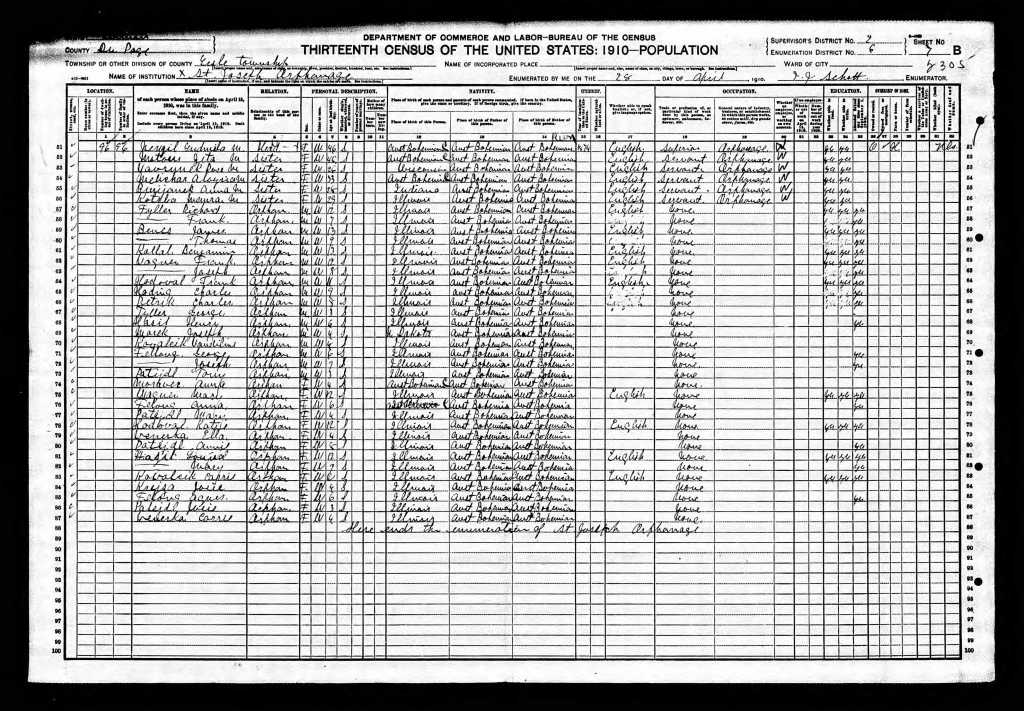
1910 U.S. Federal Census

Sources

Benevolent Institutions 1910. Prepared by Department of Commerce: Bureau of the Census. Washington: Governmental Printing Office. 1913. https://books.google.com/books?id=fmgGAQAAIAAJ.

Children Under Institutional Care. Prepared by the Bureau of the Census. Washington, D.C.: Governmental Printing Office. 1927. https://play.google.com/store/books/details?id=PFXZTGK-ZyAC&rdid=book-PFXZTGK-ZyAC&rdot=1.

Sister Mary Agatha Allison, “A Study of the Catholic Institutions for Dependent Children in the Archdiocese of Chicago Emphasizing Vocational Education,” Loyola University (1933).

Sixth Annual Report of the Department Visitation of Children Placed in Family Homes, Board of Administration of the State of Illinois, For the Year Ending December 31, 1911. 1914. Springfield, Illinois: Illinois State Journal Co., State Printers. https://www.google.com/books/edition/Report_for_of_the_Department_Visitation/e1I9AQAAMAAJ.

“St Joseph Bohemian Orphanage and Chapel,” John A Mallin, https://johnamallin.com/project/st-joseph-bohemian-orphanage-chapel/.

“The Story of US Orphanages: Illinois.” Former Children’s Homes. Accessed on 23 July 2022. http://www.formerchildrenshomes.org.uk/illinois.html.


[1] Sister Mary Agatha Allison, “A Study of the Catholic Institutions for Dependent Children in the Archdiocese of Chicago Emphasizing Vocational Education,” Loyola University (1933), 31.

[2] Sister Mary Agatha Allison, “A Study of the Catholic Institutions for Dependent Children in the Archdiocese of Chicago Emphasizing Vocational Education,” Loyola University (1933), 31.

[3] Sister Mary Agatha Allison, “A Study of the Catholic Institutions for Dependent Children in the Archdiocese of Chicago Emphasizing Vocational Education,” Loyola University (1933), 31.

[4] Sister Mary Agatha Allison, “A Study of the Catholic Institutions for Dependent Children in the Archdiocese of Chicago Emphasizing Vocational Education,” Loyola University (1933), 31.

[5] Sister Mary Agatha Allison, “A Study of the Catholic Institutions for Dependent Children in the Archdiocese of Chicago Emphasizing Vocational Education,” Loyola University (1933), 31.

[6] Sister Mary Agatha Allison, “A Study of the Catholic Institutions for Dependent Children in the Archdiocese of Chicago Emphasizing Vocational Education,” Loyola University (1933), 31.

[7] Sister Mary Agatha Allison, “A Study of the Catholic Institutions for Dependent Children in the Archdiocese of Chicago Emphasizing Vocational Education,” Loyola University (1933), 31.

[8] “St Joseph Bohemian Orphanage and Chapel,” John A Mallin, https://johnamallin.com/project/st-joseph-bohemian-orphanage-chapel/.