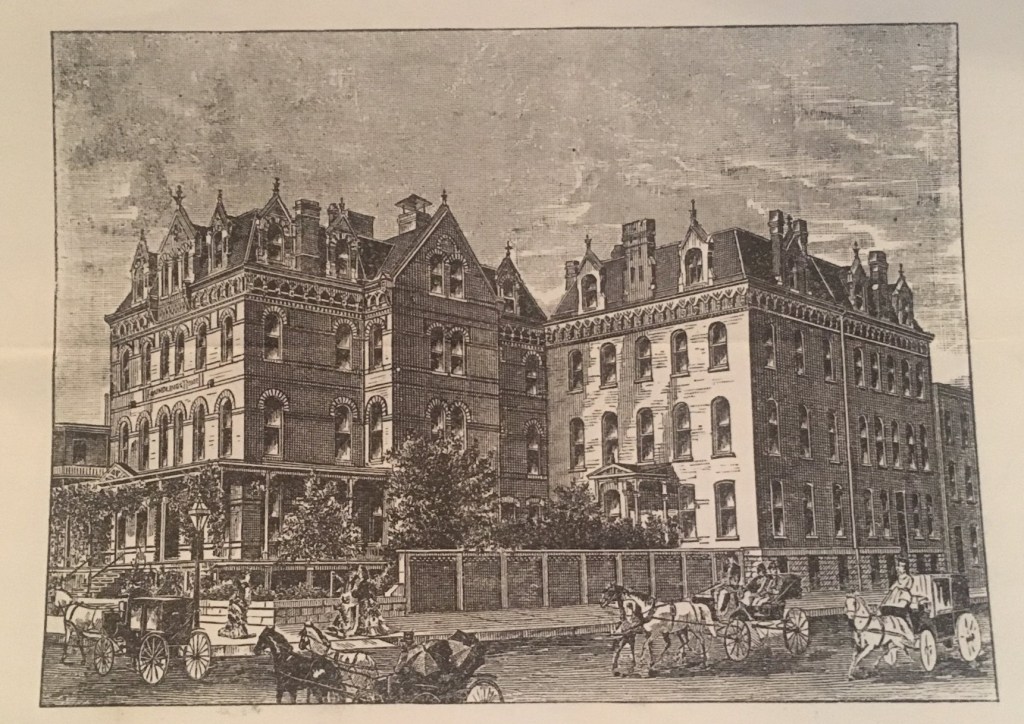
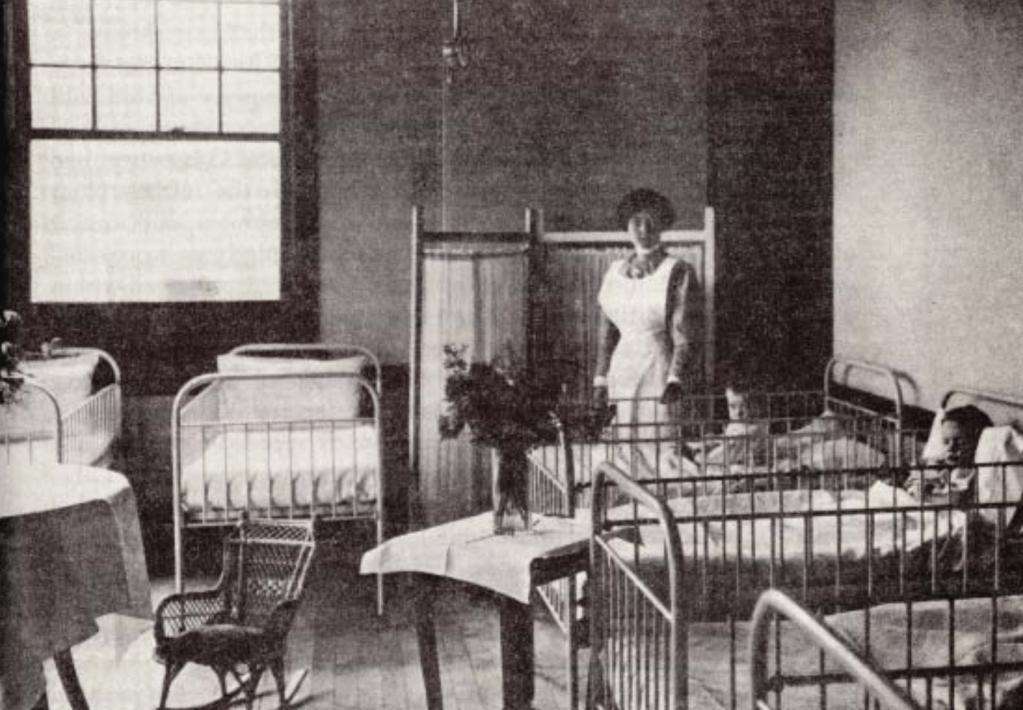
William Raymond Champlin Memorial Home. Image from 1913 Annual Report.
The All Saints Home for Boys opened on 1 November 1896 in Austin, Illinois.[1] Today, Austin is a neighborhood of Chicago. The home opened with six boys, who were, for about a year, boarded out.[2] The home owes its origin to Father John M. Chattin, a priest of the Episcopal Church who was connected with the Cathedral of St. Peter and St. Paul.[3] Chattin was a city missionary who visited the County Poorhouse, jail, and hospital (the Home for Incurables), as well as the Home for the Friendless and Bridwell frequently.[4] With consent but not the official aid of the Bishop he started the home by putting himself at the head of a household of four needy boys, which became six.[5][6]
In May 1897, the home was moved to Ohio Street in Austin and a year following that, the Home was moved to 19 Bishop Court in Chicago where it stayed for two years.
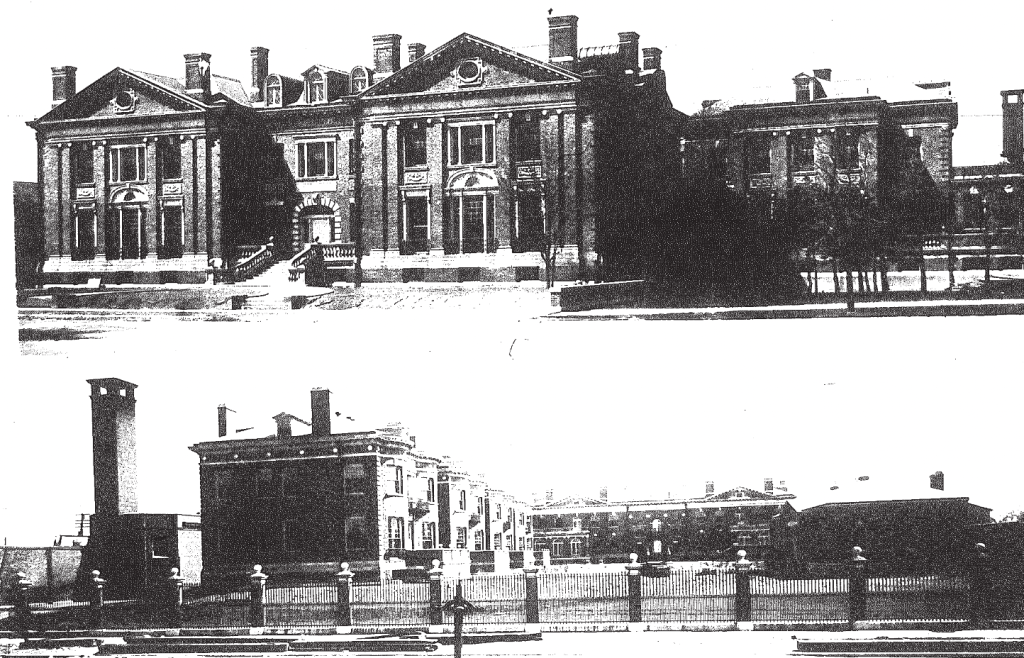
In 1900, the organization appealed to Mrs. George W. Champlin, who gave her home at 1508 West Adams Street to Rev. William E. McLaren for the purpose of maintaining a permanent home for boys.[7][8] Her donation enabled the institution to care for more residents than for in a leased building, so in 1903, a corporation was formed known as the “William Raymond Champlin Memorial Home for Boys.”[9] The home saw a lot of growth in the next few years, purchasing the two houses east of the Champlin home and, later, the third house east on the corner of Laflin Street.[10]
In 1906, a new corporation was formed, its objects being identical with the Champlin memorial home, called “Chicago Homes for Boys.”[11]
1913: “The Object of the Home from the first was preventative rather than reformatory, and any blameless boy was gladly admitted whether he could pay board or not.” [13]
Type of Institution
Dependent: Children
Location and Building
Main Location
Address:
511-517 West Adams Street[14]/1508 West Adams Street.[15] (today’s modern address)
The All Saints Home for Boys opened on 1 November 1896 in Austin, Illinois.[1] Today, Austin is a neighborhood of Chicago. The home opened with six boys, who were, for about a year, boarded out.[2] In May 1897, the home was moved to Ohio Street in Austin and a year following that, the Home was moved to 19 Bishop Court in Chicago where it stayed for two years. By 1903, the organization appealed to Mrs. George W. Champlin, who gave her home at 1508 West Adams Street to Rev. William E. McLaren for the purpose of maintaining a permanent home for boys.[3] Her donation enabled the institution to care for more residents than for in a leased building, so in 1903, a corporation was formed known as the “William Raymond Champlin Memorial Home for Boys.”[4]
Institution Name and Type
Object/Goal: “The object of the Home from the first was preventive rather than reformatory, and any blameless boy was gladly admitted whether he could pay board or not.”[5]
Dr. George E. Shipman and his wife opened the Foundlings Home in 1871. The Shipmans were, according to many newspaper accounts and primary sources, inspired by the work of George Müller in Bristol and Dr. Charles Cullis in Boston.
In 1874, the organization moved to a four-story building at 115 South Wood Street in Chicago, later 15 South Wood Street—when Chicago changed its street numbering systems (one of the times—this happened quite a few times in the city’s history).[1] The Home was near the Brown School and developed a partnership with the school. Frances Shipman, the daughter of Dr. Shipman, taught sixth grade at the Brown School. “When the Home was opened, its main object was to save the forsaken children, and it was not considered best to give any way. But it was not many months before it was made apparent to us that such was not the will of our Heavenly Father, and since then the children have been given to those who offered them Christian homes; and who can estimate the blessings which these little ones have carried with them into the homes of their adoption… More than three hundred children have been given into professedly Christian families.”[2]
In 1971, at exactly 100 years old, the Home closed because of pregnancy prevention, the number of babies born out of wedlock, and the greater acceptance of single motherhood. The following year, the building was sold to Rush-Presbyterian-St. Luke’s Medical Center for use as a mental health treatment center.
In 1960, a new home was built at 1720 W. Polk.[3] By 1962, the Foundlings Home “provides a maternity home for unwed mothers, a nursery and a detailed adoption program, among other services.”[4]
The charity is still active as the Chicago Foundlings Home. Currently, the organization works to support charitable organizations that provide education, care, and other services in communities to expecting mothers, mothers, children, and infants.
Institution Name and Type
Alternative Names:
Chicago Foundlings Home
Chicago Foundlings’ Home
Goal/Objects:
1905: “To care for abandoned infants and homeless mothers with infants.”[5]
Type of Institution:
Dependent : Children : Orphanage
Dependent : Homeless : Women
Dependent : Women : Mothers
1905:
Class II. Relief for Destitute, Neglected and Delinquent Children—Division I. Asylums, Homes, and Cheap Lodgings for Children[6]
Dates of Name, Place, Mission Change, or Merger: 1874
Moved to Wood Street
Successor: Chicago Foundlings’ Home Charity
Administration:
1910: Private Corporation
Funding and Support: Supported by voluntary contributions.[10]
The Ladies’ Union Aid Society of the Chicago Foundlings’ Home was established in the first year of the homes’ history and were a group that raised money, knitted and sewed clothing for the infants, and more.
The Chicago Relief and Aid Society often donated to the home.
Carter H. Harrison, Cook County Commissioner, donated his entire salary to the Foundlings’ Home in July 1873.[11]
People
Matilda B. Carse, social reformer, leader of the temperance movement, and donor to the Foundlings Home for many years.
C. H. Chase, member of the board in 1879.
E. G. Clark, president in 1905.
Thomas C. Dickerson, one of the corporators of the home.
John Dillingham, one of the corporators of the home.
Dr. T. C. Duncan, served as a physician throughout the 1870s and onwards.
Dr. R. N. Foster, assisted as a physicians in the 1870s when called on.
Rev. C. D. Helmer, one of the corporators of the home.
William G. Hibbard, Esq., one of the corporators of the home and served as President in the 1870s and 1880s. Treasurer in 1905.
Dr. Henrietta A. Howe, resident physician since 1888-at least 1910.
S. A. Kean, one of the corporators of the home and served as President in 1880s.
A. E. Kittredge, one of the corporators of the home.
W. C. McCallum, member of the board in 1879.
Dr. J. P. Mills served as physician throughout the late 1870s and onwards.
Emma A. Peck, matron in 1905.
J. L. Pickard, one of the corporators of the home and President of the Board of Corporators before 1879.
Rev. H. N. Powers, one of the corporators of the home.
Frances F./C. Shipman, Superintendent in 1905, 1910 and 1916.
George E. Shipman, founder and superintendent.
Dr. H. N. Small, assisted as a physicians in the 1870s when called on.
C. A. Weirich, resident physician in 1910.
Dr. C. A. Werrick
Past Residents
Percilla, a blind girl who was in the home since infanthood attended school in 1916
An Infant, 1879. “An infant, wrapped up comfortably and lying in a basket, was left early last evening on a rear veranda of the residence of Lyman Baird, No. 336 North La Salle Street. It was sent to the Foundlings’ Home.”[12]
Frances Alice Johnson was an infant who was taken to the Foundlings’ Home in 1877 after her mother, who is unfortuanately just named “Mrs. Johnson” in newspaper articles disappeared: “Mrs. Johnson, late of 540 Wabash avenue, whose disappearance was noted in The Inter Ocean of yesterday, has not turned up. The babe she left behind her was taken before Justice Summerfield, who christened it Frances Alice Johnson, and then consigned it to the Foundlings Home. Say, Mrs. Johnson, nobody believes that you’ve been and gone and done what you threatened to do, so please come out of your hiding place and take your baby, and nurse it like a sensible woman. The Foundlings’ Home is pretty full just now, and it can’t be any great satisfaction to you to look in the monthly report and see such an item as: ‘Dec. 13. ‘Nother baby found in the basket to-day. A big policeman flung it in, rang the bell, and run away. Such a sweet little creature, etc.’ There’s no solid comfort in anything like this, Mrs. Johnson, so please go and get that baby.”[13]
Unfortunately, looking at the newspaper article from the day prior, it gives an account of what may have happened to Frances’ birth mother: “Four weeks ago a woman giving the name of Mrs. johnson took furnished room at 560 Wabash avenue. She was a woman about 33 years old, rather tall, had dark hair and eyes and high cheek bones, and usually wore—and did when last seen—a brown stuff dress and light-colored scarf. She paid her rent regularly, and though not very communicative, referred at times to her husband, Frank Johnson, whom, she said rather vaguely, was a patent right’s man, and at present travelling in Iowa. Ten days ago Mrs. Johnson required the services of a medical man, and the result was an addition to the house of Johnson of a healthy female child. The young one throve, and the mother, it is said, seemed attached to it, and got along nicely herself. About 11:30 o’clock yesterday morning Mrs. Johnson left the house, and not having returned late in the afternoon her room was searched, where the child was found, and also a note laid on the table, which stated that the writer would never return, as she had gone out to commit suicide by drowning. While there is a possibility of the woman’s mind having become unsettled, the affair is also suggestive of a case of child desertion, and the police are investigating.”[14]
Intake Information and Requirements
Intake Gender/Sex:
1880: Adult females
Adult females who served as wet nurses, called “nurses” in the Ninth Annual Report: “The most of these have come to us in great sorrow; many entirely disowned by all who once loved and cared for them, were glad to find shelter anywhere… When they can no longer act in the capacity of wet nurses, the most of them go out to service or to work at their trades… but, if, for any cause, they are thrown out of a place, they return to the Home till they can find another place.”[15]
“Including the latter, and exclusive of the eighty one nurses, fifty friendless or homeless women have been admitted during the year.”[16]
Adult: Female
Children: Female, Male
Intake Age:
1923: Adults, Children from birth to 5 years
Intake Ethnicity/Race:
1910: All
1923: All
Intake Specifics: Few commitments by the court; many foundlings placed through Illinois Children’s Home and Aid Society; 1910: Foundlings, and homeless mothers with infants
1880: “The most of these [the babies] are taken in during the first month. None older than this would be taken in, if we could help it… sometimes it is left in the vestibule in the middle of the night; sometimes a policeman brings it from a remote part of the city… As far as possible, they are given to wet nurses. It happened once or twice, during 1879, that we had wet nurses enough for all the babies, but it was only for the short time. Generally, we have from five to twenty little ones whom we attempt to bring up by hand. The babies are mostly born in Chicago, though a small proportion of the mothers, as far as they are known to us, are residents of the City. They come from all parts of the State and from other States even, so that, so far as the beneficiaries of the Home are concerned, it is far from being a Chicago Institution.”[17]
Number of Residents:
1871: 117 foundlings were received of whom 82 died, 11 were given away, 1 was sent to the County house, 4 were returned to the parents. At the end of the year there was 19 foundligns in the home. Of the residents, 67 were boys and 50 were girls.[18]
Week of 22 September 1875: Five died at the Foundlings’ Home in the past week.[19]
1880: 81 adult women, who served as wet nurses, admitted in the past year.[20]
1880: 50 friendless or homeless women admitted during the year.[21]
1880-1881: During 1880, the Home took in about 400 babies, mostly under one month old.[22]
The Chicago Foundlings Home website states that they are in the process of digitizing their collections, but people are welcome to email them on their contact page, and “we will send you a note when our information page is updated and we will share additional resources for you to find the relevant records.”
Chicago Foundlings’ Home Account Book [Manuscript] 1884-1922
Note: this report begins after the Ninth Annual report in this digitization.
Shipman, George E. 1884. God’s Dealings with the Chicago Foundlings’ Home: Being a History of The First Four Years of the Home, from January 30, 1871, to January 30, 1875. Chicago: The Foundlings’ Home. https://www.google.com/books/edition/Annual_Report/CV0nAQAAMAAJ.
Other Publications
Newspaper articles from the 1870s point to a publication called Record, or the Foundlings’ Record, which was the publication of the home. Much of it is published in The Chicago Tribune.
Faith’s Record was the alumni publication of the Foundlings’ Home since 1877.[25]
Shipman, George E. 1884. God’s Dealings with the Chicago Foundlings’ Home: Being a History of The First Four Years of the Home, from January 30, 1871, to January 30, 1875. Chicago: The Foundlings’ Home. https://www.google.com/books/edition/Annual_Report/CV0nAQAAMAAJ.
Illinois Department of Visitation of Children Placed in Family Homes. 1912. Sixth Annual Report of the Department Visitation of Children Placed in Family Homes, Board of Administration of the State of Illinois, For the Year Ending December 31, 1911. Springfield, Illinois: Illinois State Journal Co. https://www.google.com/books/edition/Report_for_of_the_Department_Visitation/e1I9AQAAMAAJ.
[2] Shipman, George E. 1884. God’s Dealings with the Chicago Foundlings’ Home: Being a History of The First Four Years of the Home, from January 30, 1871, to January 30, 1875. Chicago: The Foundlings’ Home. https://www.google.com/books/edition/Annual_Report/CV0nAQAAMAAJ. 5-6.
[3] “New Home Realizes Dr. Meyer’s Dream.” 1960. Suburbanite Economist, 27 January 1960. Page 13.
[4] “Foundlings Home Exhibit Feature.” 1962. Arlington Heights Tribune, 28 June 1962. Page 5.
[23] Illinois Department of Visitation of Children Placed in Family Homes. 1912. Sixth Annual Report of the Department Visitation of Children Placed in Family Homes, Board of Administration of the State of Illinois, For the Year Ending December 31, 1911. Springfield, Illinois: Illinois State Journal Co. https://www.google.com/books/edition/Report_for_of_the_Department_Visitation/e1I9AQAAMAAJ. 173.
[24] Illinois Department of Visitation of Children Placed in Family Homes. 1914. Seventh Annual Report of the Department Visitation of Children Placed in Family Homes, Board of Administration of the State of Illinois, For the Year Ending December 31, 1913. Springfield, Illinois: Illinois State Journal Co. https://books.google.com/books/about/Annual_Report_of_the_Department_of_Visit.html?id=yR11ZIBTRwIC. 30-31.
[25] “Foundlings Home Exhibit Feature.” 1962. Arlington Heights Tribune, 28 June 1962. Page 5.
The Metropolitan Children’s Home was organized in 1903 by the Metropolitan Church Association. It was located at 1541 Franklin Boulevard.
According to 1908 newspaper articles, the Metropolitan Church Association sold property at the northwest corner of Franklin boulevard and Kedzie avenue, 50×150 feet, to Edwin S. Mason in July 1908.[1] Thus, the home likely closed in 1908 or before.
Institution Name and Type
Object/Goal: “Care of orphan and needy children.”[2]
The Beulah Home and Maternity Hospital was founded in 1896 by Mr. and Mrs. O. H. Richards. It was located at 2142-2144 North Clark Street in Chicago. Oddly enough, the area itself is notorious in Chicago History, as two doors down from the Home, seven members and associates of Chicago’s North Side Gang were murdered in the Saint Valentine’s Day Massacre (14 February 1929).
The Beulah Home and Maternity Hospital is not only connected to the dark side of Chicago history through its geographical relationship to the Saint Valentine’s Day Massacre but was also the place of suffering for many women who came to the home seeking help.
In 1913, the Curran commission, a committee created by the Illinois State House of Representatives to inquire into the methods and actions of charitable institutions and organizations licensed by the State of Illinois, visited the home. They found that in 1913, the women and expectant mothers were living in deplorable conditions and having to do difficult physical work, such as scrubbing floors, cleaning, etc. all the way up to giving birth and shortly thereafter.[1] “In order to force the girls to work, even when they are in no condition to do work, they are threatened with being thrown out. At least one girl was forced out under this rule, and she sought refuge in the Chicago Maternity Hospital.” “We find that these conditions exist because of the attitude of the superintendent, Mr. Richards, as they all seem to exist by his direction or acquiescence. We do not believe that any of the directors are cognizant of any of these conditions.”[2]
During the Curran legislative committee, Dr. Macy B. Weinberg charged O. H. Richards with cruelty, stating, “I think that Richards is mentally unbalanced… He has two hobbies, illegitimacy and the Bible. He talks of the first and quotes the second to the girls constantly. He recites passages of the Bible to them that I would not even repeat. He tells the girls that they put on tight skirts to attract men and that they deserve all they get. He tells them they should lie down on the floor and lick up the crumbs like dogs. Besides that, Richards shows a peculiar interest in the identities of the men responsible for the condition of the girl. Some of the girls believes he uses this knowledge for his personal interest.”[3]
When Weinberg was asked about Richards’ financial condition, she answered, “I know that he now lives in luxury in a beautiful home… Whereas, before he took charge of the Beulah Home, he lived in apparent poverty.”[4]
Shortly after this investigation, Richards departed as superintendent of the Beulah Home.
In addition to this investigation, it came out in the 1930s that a doctor connected to the Home operated what could be called a “baby farm” in Michigan—Rev. Edward L. Brooks operated out of Illinois, Michigan, and Wisconsin. In Beulah, Michigan, he faced harsh criticism, “Those neighbors never did approve the resort for unmarried mothers and baby bastards which this retired Congregational clergyman operated at Beulah. They suspected that Brooks let poor babies die or even had them killed, that he buried them in the dune sand among the second growth birches of his 80-acre place where brambles and goat tracks quickly erased all trace of the graves.”[5] He faced murder charges for his baby farm in Beulah, Michigan. He was cleared on the charges brought in Chicago.
After the death of a mother and child at the Home in 1927, the hospital faced extreme scrutiny, however it was not until 1934 when its license was revoked. In 1935, the president of the Chicago Board of Health said “the revocation followed receipt of complaints that conditions about the hospital were insanitary and that unwanted babies were disposed of.”[6]
Institution Name and Type
Alternative Names: Beulah Home; Beulah Home and Hospital; Beulah Home for Girls; Beulah Home for Unfortunate Women
Type of Institution: Maternity, Orphanage
Location and Building
Address: 2142-2144 North Clark St.
Locality: Chicago
County: Cook
State: Illinois
Notes on the buildings: No longer exists.
The building sat two doors from the garage where seven Chicago bootleggers were massacred on St. Valentine’s Day in 1929.[7]
The Beulah Home was comprised of four three-story brick buildings.[8]
Administration Information
Date of Founding: 1896
Dates of Name, Place, Mission Change, or Merger:
Date of Closure: 1934
Related to: Brooks Farm, Beulah, Michigan
Administration: Private (founded by Mr. and Mrs. O. H. Richards)
Support/Funding: north side churches and North Side Women’s Club.[9]
Notable People
Rev. Edward L. Brooks
Dr. Alice Lindsay Wynekoop, Chicago doctor who was convicted and served time for murdering her daughter-in-law and sent many cases to Dr. Brooks from Illinois.[10]
Dr. S. M. Todd, woman physician who served as house physician and resident doctor around 1916.[11]
O. H. Richards, superintendent and founder of the home.[12]
1913: Expectant mothers of illegitimate children are sent to this home by courts, the United Charities, and by pastors of churches.[16]
1916: Mother must remain at the home and care for her baby for at least 6 months. Girls are received from the Juvenile and municipal courts, charity organizations, police, “responsible individuals,” etc.[17]
Placement Specifics:
1910: Placement of babies through Illinois Children’s Home and Aid Society if necessary.[18]
1913: In the 18 years of its existence only three children have been placed in family homes.[19]
Number of Residents:
1913: 10 expectant mothers were in resident during the committee’s visit.[20]
1916: Five children and 13 girls were residents at the time of an inspection in June 1916.[21]
Past Residents:
Evelyn Smith was a resident of the Beulah Home and Maternity hospital in 1925. She gave birth to a child on 20 December 1925. At the time of the child’s birth she was attended to by only Miss Frances McCleary, a self-trained nurse. The child only lived 40 minutes and Evelyn passed away on 29 December 1925.[22]
Ethel Tilbury, also known as “LittleEthel”was a 12 year old girl who gave birth to a baby in Beulah Home in 1910.[23] According to a 1913 investigation, “The home acquired a great deal of advertising and contributions through the exhibition of Ethel Tilbury, a little twelve year old mother. Pictures of her and her baby were taken and these were used to advertise her very much to her detriment. People who came to the home were always shown Ethel Tilbury.”[24]
Irene Carr was 15 years old when she came to Beulah on 5 January 1912. The day after arriving she was “required to scrub six flights of stairs in four apartment buildings, the third floor of the hospital, the chapel, and the dining room floor. She then waited on 52 girls, set the table, cut all the bread… The day before her baby was born she scrubbed eight flights of stairs in the above institution, swept out the chapel, cleaned out the store room and lifted heavy trunks. She had been sick in bed, but she was taken down the stairs and had to wait on all the girls, and later scrub the chapel. While weak with labor pains she had to sit through a sermon delivered by the superintendent. The next day she was on the table eleven hours and the instruments were on the baby five or six hours. She could not be given chloroform on account of her weak heart, and accordingly heard all that was said. In delivering the baby one of its eyes was punched out, but the eye was put back into place. On the eleventh day she got up, swept thirteen rooms and scrubbed on her hands and knees, and the stitches broke, and after the wound was sewed up again she left the home. Richards [the superintendent] made no effort to prosecute the man that caused her ruin.”[27]
Mary Lapalla gave birth to a daughter at Beulah Home in May 1907. She confessed on 30 May 1907, that she had killed her two week old daughter by throwing her into the lake.[28]
Evelyn Frechette was the lover of bank-robber John Dillinger. A few years before she met Dillinger, she gave birth to an infant son, William, in the Beulah Home in 1928. The infant was taken to Brooks’ Michigan farm and died at the age of 3 months.[29]
Records
1916: “The books of the institution are carefully kept by the treasurer… Most of the records are kept in large envelope on the outside of which is a brief and yet comprehensive record, consisting of date, nativity, name and children, if any, sex, name of girl’s parents, brothers and sisters, occupation, by whom sent and from where sent, church, condition, city, county, date of baby’s birth, sex and disposition made of child. All correspondence is kept in these envelopes. Clerical records are kept in each and every case and are filed for future reference.”[30]
Archives and Museums
Chicago History Museum
“Welfare Council of Metropolitan Chicago records, 1914-1978”
Illinois Department of Visitation of Children Placed in Family Homes. 1917. Biennial Report for 1914-1915 of the Department Visitation of Children Placed in Family Homes, Including Reports of Inspection of Institutions for 1916, For the Year Ending in December 31, 1915. 1917. Springfield, Illinois: Illinois State Journal Co., State Printers. https://www.google.com/books/edition/Annual_Report_of_the_Department_of_Visit/04eICtl2WFwC?hl=en&gbpv=1.
[1] “Maternity Hospitals.” 1913. Found in Journal of the House of Representatives of the 48th General Assembly of the State of Illinois: Regular Biennial Session. Springfield, Illinois: Illinois State Journal Co. 1238-1239.
[6] “Trace Chicago Clews in Baby Farm Inquiry,” Chicago Tribune, 25 January 1935, p. 1, col. 5.
[7] “Rev. Edward L. Brooks, Brooks Farm and Beulah Home.” 1935.
[8] Illinois Department of Visitation of Children Placed in Family Homes. 1917. Biennial Report for 1914-1915 of the Department Visitation of Children Placed in Family Homes, Including Reports of Inspection of Institutions for 1916, For the Year Ending in December 31, 1915. 30.
[9] Illinois Department of Visitation of Children Placed in Family Homes, 1917. 32.
[10] “Rev. Edward L. Brooks, Brooks Farm and Beulah Home.” 1935.
[11] Illinois Department of Visitation of Children Placed in Family Homes, 1917. 31.
[12] “Maternity Hospitals.” 1913. Found in Journal of the House of Representatives of the 48th General Assembly of the State of Illinois: Regular Biennial Session. Springfield, Illinois: Illinois State Journal Co. 1238-1239.
[13] Illinois Department of Visitation of Children Placed in Family Homes, 1917. 32.
[14] Illinois Department of Visitation of Children Placed in Family Homes, 1917. 32.
[15] “Maternity Hospitals.” 1913. Found in Journal of the House of Representatives of the 48th General Assembly of the State of Illinois: Regular Biennial Session. Springfield, Illinois: Illinois State Journal Co. 1238-1239.
The Bethel Home for Women and Convalescent Children was founded around 1911. However, it appears to have been organized prior to 21 April 1910, as the building was enumerated in the 1910 Census.
In May 1913, The Day Book (a publication in Chicago) ran a story about the Bethel Home for Convalescent Women and Children and Mrs. Evangeline Barron, the matron and superintendent of the home. In the article, it describes how the United Charities organization refused to endorse the Bethel Home, forcing Barron to shut it down.[1]
There are few clues to the history of Bethel Home besides those in newspaper articles.
However, it is unclear as to how long Bethel Home was closed. One strange article about Mrs. Barron was published in the Chicago Tribune in 16 September 1913, “Mrs E. Barron in Wisconsin: Reports that she mysteriously disappeared prove to have been unfounded—Now at Lake Geneva,” which states, “Mrs. Evangeline Barron, former matron of Bethel home, 522 East Thirty-Fourth Place, who was reported as having disappeared in a letter sent to The Tribune, was located yesterday at Lake Geneva.”[2] This indicates that the home was either closed or Barron was no longer matron of the home sometime before 16 September 1913. Yet, just days later on 28 September 1913, the Chicago Tribune published a brief about the Calendar Club of the Bethel Home and states, “The Calendar club was organized last week at a meeting of philanthropic women at the Blackstone hotel, the society to work for the good of the Bethel Home for Convalescents, of which Mrs. Evangline Barron is head resident.”[3] It seems that the home could have been temporarily closed between May and September 1913.
Activities of Barron and Bethel Home resumed in late September 1913, as evident in newspaper articles, including the news story “School of Eugenics Planned for Bethel Home,” which describes that Mrs. Evangeline Barron was planning “to start a school of eugenics in connection with the Bethel Home for Convalescent Women and Children. Mrs. Barron is head resident of the home.”[4] Additionally, the Calendar Club, which was a society of women that raised money for the Bethel Home, was in the process of securing funding to purchase the home’s property in October 1913.[5]
In 1914, it was a certified orphanage.[6] However, there are no mentions of Bethel Home in Chicago’s Social Service Directory of 1915, or any other sources consulted after 1915.
1911: “Commitments: During the year of 1911 one colored boy was committed to their care.”[10]
Intake Specifics:
1911: “Only convalescents are admitted to this institution, and no males over eight years of age. Will admit from any institution, or upon recommendation of any reputable physician, unless suffering from contagious disease. An exception was made recently in the case of a man and his wife, once wealthy, discharged from the Cook County Hospital friendless and without money. The man is now a cashier in a restaurant on a small salary, and is in the home only at night. His wife is a very capable helper about the home.”[11] 1 child was committed by the court, 18 others were received otherwise or present at the beginning of the year. 16 children were discharged with their mothers. 2 men were admitted, and 78 females were admitted.
Number of Residents:
1911: 1 child was committed by the court, 18 others were received otherwise or present at the beginning of the year. 16 children were discharged with their mothers. 1 was present at the end of the year, and 2 were placed in other institutions. 70 adults were residents throughout the year. 2 men were admitted and remained until the end of the year. 78 women were admitted (10 of whom were present at the beginning of the year), 75 of which were discharged throughout the year.
Records
1911: “a fairly good record of each inmate is entered. Records are not kept in fireproof receptacle.”[12]
Unknown if records exist. No collections found through online internet searches.
1910 U. S. Census
Chicago Ward 3, Enumeration District 0221
522 East 33rd Place
Name
Relation to Head of Household
Sex
Race
Age
Marital Status
Occupation
Barron, Walter A.
Head
M
White
33
M
Can Salesman / Advertising Company
Barron, Evangelina M.
Wife
F
White
30
M
Superintendent / Charity House
Barron, Benois F.
Son
M
White
6
S
Slocharick, Annie
Lodger
F
White
19
S
Houseworker / Charity house
Slocharick, Ethel
Lodger
F
White
0
S
Mills, Julia P.
Lodger
F
White
16
S
Nielsen, Julius P.
Lodger
M
White
23
S
Houseworker / Charity House
Heslen, Theresa M.
Lodger
F
White
25
S
Expediter Dipper / Candy Factory
Heslen, Josephine M.
Lodger
F
White
0
S
Sources
Illinois Department of Visitation of Children Placed in Family Homes. 1912. Sixth Annual Report of the Department Visitation of Children Placed in Family Homes, Board of Administration of the State of Illinois, For the Year Ending December 31, 1911. Springfield, Illinois: Illinois State Journal Co. https://www.google.com/books/edition/Report_for_of_the_Department_Visitation/e1I9AQAAMAAJ.
“Mrs. E. Barron in Wisconsin,” Chicago Tribune, 16 September 1913, p. 4, col. 1.
“School of Eugenics Planned for Bethel Home,” Chicago Tribune, 6 October 1913, p. 14, col. 5.
“Tells Curran Commission How United Charities Prosecutes Those It Does Not Like,” The Day Book (Chicago, Illinois), 16 May 1913, p. 27, col. 1-2.
“The Calendar club was…” Chicago Tribune, 28 September 1913, section 5, p. 8, col. 2.
[1] “Tells Curran Commission How United Charities Prosecutes Those It Does Not Like,” The Day Book (Chicago, Illinois), 16 May 1913, p. 27, col. 1-2.
[2] “Mrs. E. Barron in Wisconsin,” Chicago Tribune, 16 September 1913, p. 4, col. 1.
[3] “The Calendar club was…” Chicago Tribune, 28 September 1913, section 5, p. 8, col. 2.
[4] “School of Eugenics Planned for Bethel Home,” Chicago Tribune,6 October 1913, p. 14, col. 5.
[5] “School of Eugenics Planned for Bethel Home,” Chicago Tribune,6 October 1913, p. 14, col. 5.
[6]The Institution Quarterly: An Official Organ of the Public Charity Service of Illinois. 1914. Volume V. Springfield, Illinois: State Board of Administration, State Charities Commission, and State Psychopathic Institute. 105.
[7] Illinois Department of Visitation of Children Placed in Family Homes. 1912. Sixth Annual Report of the Department Visitation of Children Placed in Family Homes, Board of Administration of the State of Illinois, For the Year Ending December 31, 1911. Springfield, Illinois: Illinois State Journal Co. 39-40.
[8] Illinois Department of Visitation of Children Placed in Family Homes, 1912. 170-171.
[9] Illinois Department of Visitation of Children Placed in Family Homes, 1912. 170-171.
[10] Illinois Department of Visitation of Children Placed in Family Homes, 1912. 41.
[11] Illinois Department of Visitation of Children Placed in Family Homes, 1912. 40.
[12] Illinois Department of Visitation of Children Placed in Family Homes, 1912. 41.
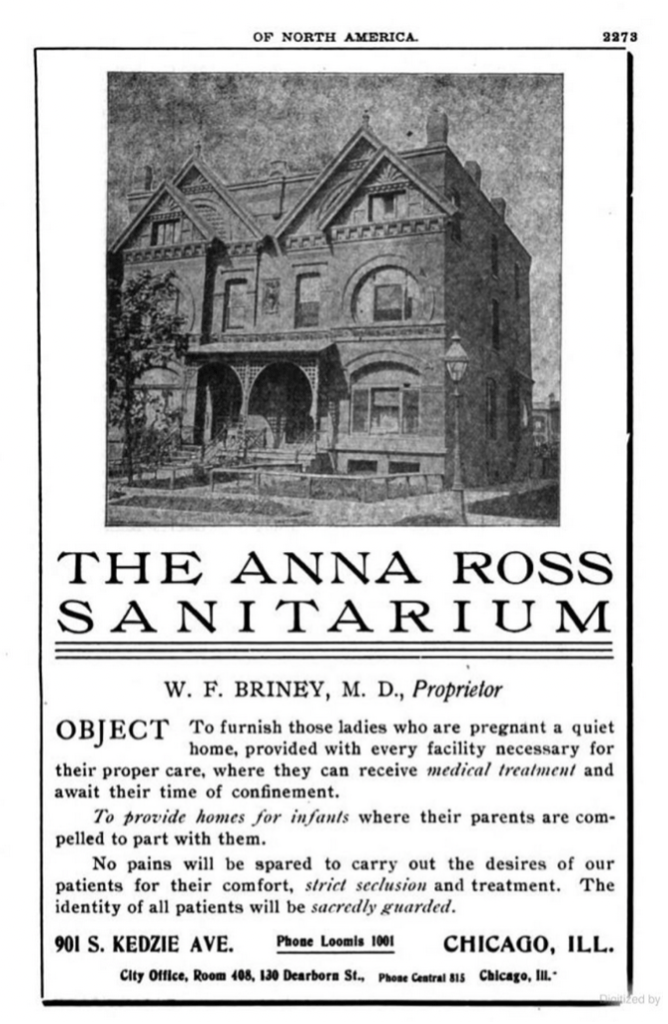
The Anna Ross Sanitarium was founded in 1900 by Dr. W. F. Briney as a home for pregnant mothers. It operated both as a maternity home and an orphanage for infants.
In 1913, under the guidance of Lieutenant-Governor Barrett O’Hara, a committee of state legislators investigated several medical institutions in Chicago, including Anna Ross Sanitarium. It was found that Dr. W. F. Briney, the administrator and proprietor of Anna Ross, admitted that he had given $20 to physicians for each patient sent to him.[1] The Curran Commission, as it was called, investigated the Anna Ross Sanitarium on 14 April 1913, finding that the “mothers who go to the sanitarium are induced to sign contracts giving away their children before the children are born. Five unmarried women were found in the place. The rates charged by the sanitarium depend on how much money the mother has.”[2]
In the investigation, and testimony to the House of Representatives by Dr. W. F. Briney, it was discovered that the institution pays a commission of 33.5% to each physician sending women to them but has no agreement with physicians.[3] Additionally, “If a mother should come back in later years and endeavor to secure information about the child placed out by this institution no information could be given as they do not aim to keep in touch with the child.”[4]
In 1914, The Day Book published an article that stated, “The report of the investigator of the commission showed that the Anna Ross Sanitarium has placed three babies with people who gave the addresses that proved to be vacant lots. Dr. W. F. Briney was unable to explain this.”[5]
In 1915, the Anna Ross Sanitarium merged with the Illinois Maternity Hospital and became the Maternity and Infant Hospital of Chicago.
Advertisement from: Polk’s Medical Register and Directory of North America. 1904. Volume II. Eighth Revised Edition. Detroit: R. L. Polk & Co., Publishers. 2273.
Advertisement from: Polk’s Medical Register and Directory of the United States and Canada. 1908. Tenth Revised Edition. Detroit: R. L. Polk & Co., Publishers. 2193.
Institution Name and Type
Alternative Names: Anna Ross Lying-In Sanitarium
Type of Institution: Maternity, Orphanage
“A Maternity Home which is run in an ethnical and Christian manner. We do no abortion work. Our home is run in a quiet and orderly manner. We assist patients in keeping their baby when they are in a position to do so. If not we find the infant a home and keep full records as to its disposition, and in all things comply with the law and ordinances. We invite Physicians to visit our place. We make full investigation before sending us patients. We meet patients at the train and look after them carefully while under our care.”[6]
Location and Building
Address: 1900 South Kedzie Avenue
1908: 901 S. Kedzie Ave.[7] (Chicago changed a lot of street numbers in 1909, including this address).
1914: 47 children placed and replaced by institution.[15]
1915: 13 children placed and replaced by institution.[16]
Previous Residents:
Bonnie Hoyt passed away in October 1902 at the Anna Ross Sanitarium. There was a large search for family members after she passed so that they could claim her body and give her a proper burial. She was a chorus girl in the “Prince of Pilsen” company for several months prior to her passing. She had joined the company in Boston. She ended up in the Anna Ross Sanitarium after becoming ill from peritonitis. On 27 October 1902, it was decided that she had to have surgery, however, she “immediately became unconscious and never recovered her senses.”[17]
Records
“If a mother should come back in later years and endeavor to secure information about the child placed out by this institution no information could be given as they do not aim to keep in touch with the child.”[18]
Unknown if records exist. No collections found through online internet searches.
Illinois Department of Visitation of Children Placed in Family Homes. 1917. Biennial Report for 1914-1915 of the Department Visitation of Children Placed in Family Homes, Including Reports of Inspection of Institutions for 1916, For the Year Ending in December 31, 1915. 1917. Springfield, Illinois: Illinois State Journal Co., State Printers. https://www.google.com/books/edition/Annual_Report_of_the_Department_of_Visit/04eICtl2WFwC?hl=en&gbpv=1.
[2] “Find Shameful Conditions in ‘Homes’ for Foundlings,” Chicago Tribune, 15 April 1913, p. 6, col. 1.
[3] “Maternity Hospitals.” 1913. Found in Journal of the House of Representatives of the 48th General Assembly of the State of Illinois: Regular Biennial Session. Springfield, Illinois: Illinois State Journal Co. 1237.
[5] “Curran Commission Turns the Searchlight on Methods of Probation Officers in the Juvenile Court,” The Day Book (Chicago, Illinois), 29 April 1914, p. 12, col. 1-2.
[6] “Department of Progressive Advertisers.” 1911. The American Journal of Clinical Medicine 18(6): 103.
[7]Polk’s Medical Register and Directory of the United States and Canada. 1908. Tenth Revised Edition. Detroit: R. L. Polk & Co., Publishers. 494.
[8]The Institution Quarterly: An Official Organ of the Public Charity Service of Illinois. 1913. Volume IV. Springfield, Illinois: State Board of Administration, State Charities Commission, and State Psychopathic Institute. 92.
[9]Polk’s Medical Register and Directory of the United States and Canada,1908. 494.
[10]Chicago Medical Recorder: January-December 1915.1915. Volume 37. Chicago: The Medical Recorder Publishing Company. 487.
[11]Polk’s Medical Register and Directory of North America, 1904. 2273.
[12]Polk’s Medical Register and Directory of the United States and Canada,1908. 494.
[13]Polk’s Medical Register and Directory of the United States and Canada,1908. 494.
[15] Illinois Board of Administration. 1917. Sixth Annual Report, Seventh Annual Report: October 1, 1914 to September 30, 1916, Inclusive. Volume I. Springfield, Illinois: Illinois State Journal Co. 141.
[16] Illinois Board of Administration. 1917. Sixth Annual Report, Seventh Annual Report: October 1, 1914 to September 30, 1916, Inclusive. Volume I. Springfield, Illinois: Illinois State Journal Co. 141.
[17] “Chorus Girl Dies Unknown.” 1902. Chicago Tribune, 29 October 1902, p.1., col. 5.
The Chicago Orphan Asylum was formed on 3 August 1849 as a response to the death and displacement caused by the worldwide cholera epidemic.[1] The Orphan Asylum was organized by a group of leaders in Chicago who were predominantly Protestant and early settlers of the city, including William B. Ogden, Orrington Lunt, Walter S. Newberry, William H. Brown, John H. Kinzie, and J. Young Scammon.[2] Ogden was Chicago’s first mayor and Newberry later became mayor of the city. Daily operations were managed by a board of women called the Board of Directresses.[3]
The official incorporation date of the Chicago Orphan Asylum was 5 November 1849.[4] The mission adopted in its incorporation was “the protecting, relieving, educating of, and providing means of support and maintenance for orphan and destitute children.”[5] According to author Mrs. Sarah Wheeler, “it was determined that no child should be bound out to service under ten years of age, but could be adopted at any time. It also permitted children of soldiers in the army, or who had been in the service of the United States, to have home in the asylum.”[6]
The first three children were admitted to the asylum on 11 September 1849.[7] The first home that the Orphan Asylum operated out of was originally in the house of Mrs. Ruth Hanson, the first Matron of the Orphan Asylum, which was situated on Michigan Avenue between Lake and Water Streets. [8] However, after a few months of fundraising, the asylum moved to Adams Street, between State and Dearborn Street, into a frame house.[9]
A short time later, the asylum moved to the Hinton House on Wells Street [Fifth Avenue], between Van Buren and Harrison Streets.[10]
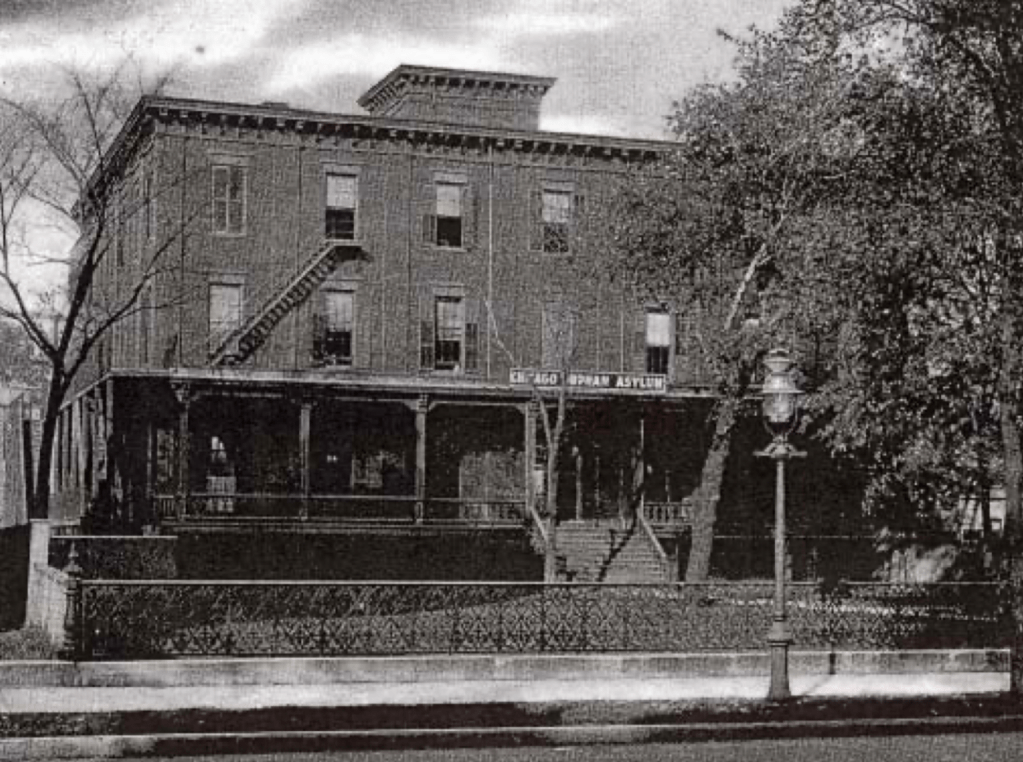
Around 1850, Mr. Johnson donated a lot of land on the north side of the river to erect a permanent building and the Orphan Asylum expanded the size of the campus by buying the surrounding land.[11] The orphanage moved in 1853 to this site, 2228 South Michigan Avenue, into a three-story brick building designed by Burling and Baumann.[12] The building was enlarged in 1884 with the addition of Talcott Hall.[13]
After the Great Chicago Fire, in October 1871, the Chicago Orphan Asylum opened its doors to assist men, women, and children. A depot for clothing distribution under the auspices of the Chicago Relief and Aid Society was set up in the parlors of the asylum and a temporary sewing room was created in a school-room for the use of a sewing society for the employment of women who lost their jobs due to the fire.[14]
The addition of Talcott Hall in 1884 included an addition to the school room and increased accommodations to a capacity of 250 children.[15] The Chicago Orphan Asylum included a school since before 1877.[16] However, as more children were admitted, it became necessary to re-organize the school and model it after the public schools in Chicago. So, secondary and primary departments were created.[17] In 1882, a primary department and kindergarten was established, which opened with an attendance of 40 children from five to seven years old.[18] In December 1883, a kindergarten opened, and it was presided over by teachers connected to the Free Kindergarten Association.[19]
In 1887, the Board of Directresses decided that all children who could pass the required exams for the third grade would be sent to the Chicago public schools.[20] Several students were able to pass and were transferred to the Mosely School and the Chicago Manuel Training School took one of the boys from the orphanage as well.[21]
Around 1891, the Chicago Orphan Asylum was maintaining three schools, with an average attendance 150 students.[22] By 1892, the School Committee of the Board of Trustees decided that all children over seven years old were to attend the public schools.[23] Upon this decision, the school departments of the orphanage were organized into one department: Kindergarten Primary.[24]
The Chicago Orphan Asylum also ran an industrial school. In 1874, a sewing school was established in the orphanage by the Directresses of the Board of Trustees for the education of both boys and girls.[25] The sewing school was later changed into an industrial school, which included sewing for the girls and the employment of a printer to teach typesetting for the boys.[26] In March 1890, it was decided to modify the plans for the industrial school, as many of the older children were attending the public schools and unable to be present at the regular class times.[27] Thus, shortly after, the Industrial School within the orphanage was closed.
On 18 November 1879, Former President Ulysses S. Grant visited the Orphan Asylum and met with the children.[28]
In 1899, the Chicago Orphan Asylum moved to 5120 South King Drive. At the time, the street was named “South Park Avenue,” but it was later renamed after Dr. Martin Luther King Jr. This building was designed by the architects at Shepley, Rutan, and Coolidge, who also designed the Allerton Wing of The Art Institute of Chicago and the original Chicago Public Library.
By the 1920s, due to changes in child-care practices and social welfare, the Chicago Orphan Asylum changed its mission from large-scale institutional, residential care for children to smaller-scale living arrangements. The Orphan Asylum moved its remaining children to a smaller rented building at 4911 South King Drive (then South Park Avenue), which has since been demolished.[29] By 1938, the Chicago Orphan Asylum began a foster care service.[30] By its 100th anniversary in 1949, the Chicago Orphan Asylum was no longer an “asylum,” as it had changed it “adopted a plan for providing foster home care for babies and children up to 6 years old.”[31]
After moving out of 5120 South King Drive, the Orphan Asylum sold the building in 1940 to the Good Shepherd Community Center, which became a significant institutional anchor in the Bronzeville community and was strongly associated with the literary and artistic movement of the 1930s and 40s known as the “Chicago Black Renaissance.” In 1957, the Chicago Baptist Institute purchased the building.[32]
The Orphan Asylum continued operating through adoption and foster care work. In 1949 it changed its name to the Chicago Child Care Society (CCCS) and later CCCS merged with Family Focus.
Institution Name and Type
Alternative Names: Chicago Protestant Orphan Asylum[33]
Type of Institution: Agency, Foster Care, Industrial School, Orphanage
The industrial school was closed shortly after 1890 (see overview for details).
By 1938, the Chicago Orphan Asylum began a foster care service.[34]
In the later years of the twentieth century, the Chicago Orphan Asylum became more focused on adoption placement, foster care, and education.
Location and Building
Address:
1849: Michigan Avenue between Lake and Water Streets, frame house
1849: Adams Street, between State and Dearborn Street, frame house
1849-1850: Hinton House on Wells Street [Fifth Avenue], between Van Buren and Harrison Streets
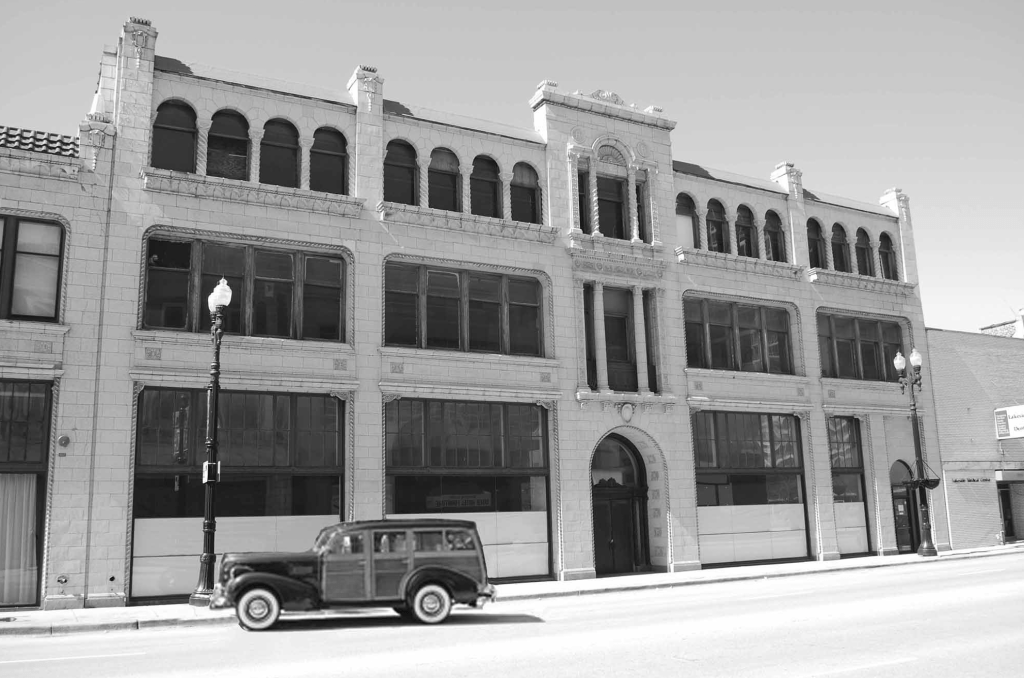
Notes on the buildings: The building at 2228 South Michigan Avenue that housed the Chicago Orphan Asylum from 1853 to 1899 was sold by the Orphan Asylum in 1899.[40] The building was torn down in the early 1920s to make room for the Marmon and Hudson Automobile Showrooms, which are now contributing to the Motor Row Chicago Landmark District.[41] The building at 5120 South King Drive still stands and is occupied by the Chicago Baptist Institute.
Administration Information
Date of Founding: 1849
Dates of Name, Place, Mission Change, or Merger:
After March 1890: The industrial school was closed as more children attended the public schools
By 1930, the Chicago Orphan Asylum began a foster care service and by 1942 was no longer a residential institution..[42][43]
1949: changed name to Chicago Child Care Society
Successor: Chicago Child Care Society
Date of Overall Closure: Not applicable. Chicago Child Care Society merged with Family Focus in 2001 and still operates today.
Administration:
1910: Private corporation
1923: Protestant churches
Contributors/Support:
Endowments, Tolcott Fund, Private contributions
The Froebel Association assumed the expenses of the school after 1883.[44]
October 1871- April 1872: the asylum received $400 a month from the A. T. Stewart Relief Fund to provide for the “maintenance of children whose widowed mothers were dependent upon themselves for support.”[46]
April 1872: $10,000 from the Executive Committee of the Chicago Relief and Aid Society.[47]
After 1881: Mrs. Mary H. Talcott, donated over $5,500.[48]
1892: “No age, race or condition have ever been turned unassisted away.”[63]
1892: “But of late years admission was confined to children from one to twelve years of age.”[64]
1910: Male max age 10, Female max age 12
1923: 1-12 years
1949: plan adopted to provide foster care for babies and children up to 6 years old, but in practice provided foster care for babies through 17 year olds.[65]
Intake Ethnicity/Race:
1892: “No age, race or condition have ever been turned unassisted away.”[66]
1904: “There is no race or color distinction with the children. Almost every nationality is represented among them.”[67]
1910: All
1923: White, Chinese, Japanese
Intake Specifics:
1872: “It was also determined to receive from the Courts vagrant and homeless children who were in no wise subjects for penal institutions, yet for whom no other places were provided. These were mostly children sent out by Eastern institutions and run-aways from home.”[68]
Before 1892: “Many little ones have but one parent who cannot always provide a home for them, and so this asylum receives them to its homelike care, for which a small amount is paid each week. Here, again, we experience the wisdom of that kindly heart Judge Thomas, who years ago, when the project was first inaugurated, introduced the word ‘destitute’ in to the Constitution. He is not the only orphaned one whose parents sleep ‘life’s dreamless sleep.’ There is a deeper orphanhood than that, when father forgets his trust and fails to provide, and mother turns from her clinging offspring, while her heart gives no response to its helpless cry. Frequently these are as evidently cases for the reception of the charity of this institution as orphans themselves.”[69]
1892: “No age, race or condition have ever been turned unassisted away.”[70]
1892: Small amount paid for the board of children who parents place them temporarily in the asylum—regular price is $1.50 a week for each child.[71]
1910: Orphan
1949: Orphans, children under the jurisdiction of the juvenile court[72]
Number of Residents:
1849-1850: 100 children were sheltered in the asylum over the first two years.[73]
“Of these was a mute, whose silent language reached the soul with an appeal which could but awaken the tenderest sympathy.”[75]
Between 1874 and 1892: over 3,680 children were admitted and 3,237 children were removed.[76]
1882: 40 children between 5-7 years old were educated in the primary school.[77]
1891-1892: 203 children, 170 were removed by their parents or friends, 10 adopted, 13 died.[78]
1892, September: 135 children from the orphanage entered public school.[79]
1922: 162 children in the home in November 1922, 255 cared for during the year.[80]
1949: more than 530 children cared for in foster homes by the Chicago Orphan Asylum.[81]
Records
“The number of children admitted to the asylum increases with every year. It became advisable for the reception committee, before whom persons came for admission, to keep an exact record of every child coming before them, its name and age, and name and nationality of parent or guardian. This plan has been faithfully carried out, and has been of great advantage in preventing imposition, and systematizing the work.”[82]
Wheeler, (Mrs.) Charles Gilbert [identified as Sarah Jenkins Wheeler]. 1892. Annals of the Chicago Orphan Asylum from 1849 to 1892. Chicago: Board of the Chicago Orphan Asylum. https://archive.org/details/annalsofchicagoo00whee.
Board of State Commissioners of Public Charities. 1880. Sixth Biennial Report of the Board of State Commissioners of Public Charities of the State of Illinois, November 1880. Springfield, Illinois: H. W. Rokker, State Printer and Binder. https://www.google.com/books/edition/_/OobIAAAAMAAJ.
—. 1884. Eighth Biennial Report of the Board State Commissioners of Public Charities of the State of Illinois, November 1884. Springfield, Illinois: H. W. Rokker, State Printer and Binder. https://www.google.com/books/edition/_/DKTIAAAAMAAJ.
Illinois State Charities Commission. 1911. Second Annual Report of the State Charities Commission to the Honorable Charles S. Deneen, Governor of Illinois. Springfield, Illinois: Illinois State Journal Company. https://www.google.com/books/edition/Annual_Report/pFgZAQAAIAAJ.
—. 1927. Children Under Institutional Care, 1923: Statistics of Dependent, Neglected, and Delinquent Children in Institutions and Under the Supervision of Other Agencies for the Care of Children, with a Section on Adults in Certain Types of Institutions. Washington, D.C.: Governmental Printing Office. https://play.google.com/store/books/details?id=PFXZTGK-ZyAC&rdid=book-PFXZTGK-ZyAC&rdot=1.
Wheeler, (Mrs.) Charles Gilbert [identified as Sarah Jenkins Wheeler]. 1892. Annals of the Chicago Orphan Asylum from 1849 to 1892. Chicago: Board of the Chicago Orphan Asylum. https://archive.org/details/annalsofchicagoo00whee.
[1] Chicago Department of Zoning and Land Use Planning. 2008. “Landmark Designation Report: Chicago Orphan Asylum Building, 5120 S. King Dr.” Chicago: City of Chicago. 2.
[2] Chicago Department of Zoning and Land Use Planning, 2008. 2.
[3] Chicago Department of Zoning and Land Use Planning, 2008. 2.
[29] Chicago Department of Zoning and Land Use Planning, 2008. 22.
[30] Meinzer, Helen S. 1938. “Sources and Methods of Seeking Foster Homes Used by Seven Child Placing Agencies.” Child Welfare League of America Bulletin 23 (9): 1-9.
[31] “Orphan Asylum Group to Mark 100 Years’ Care.” Chicago Tribune (24 October 1949), p. 29, col. 3-6.
[32] Chicago Department of Zoning and Land Use Planning, 2008. 1, 5.
[33]Chicago: An Instructive and Entertaining History of a Wonderful City. With a Useful Stranger’s Guide. 1888. Chicago: Rhodes & McClure Publishing Co. 222.
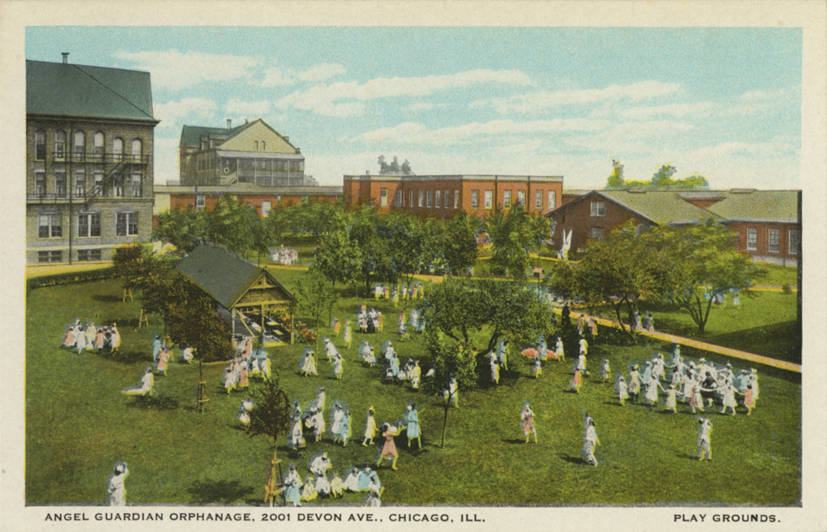
The Angel Guardian Orphanage was opened in 1865 in response to the increasing population of German Catholic orphans needing care in Chicago. The mission was created by give German Roman Catholic parishes in Chicago, which included St. Joseph’s and St. Michael’s, under the leadership of Father Holzer.[1] Chicago Bishop James Duggan blessed the orphanage and assigned the management to the St. Boniface Cemetery Association.
The orphanage was located on a 40-acre campus near Devon and Ridge in West Ridge (Rogers Park), Chicago.
Initially, the Poor Handmaids of Jesus Christ were recruited from Germany to take charge of the facility. The land was purchased from Mr. and Mrs. Chauncey Trumble.
The orphanage went by many names throughout its history, first known as “German Roman Catholic Orphanage of the Holy Guardian Angels at Rose Hill near Chicago.” [2]
At the turn of the century, in response to the wider social welfare debate between institutionalization and home placement, the orphanage changed after 1916 to a “cottage system” in which small groups of children shared a single living quarters and dining facility. On the Angel Guardian Orphanage Alumni Website, past residents often mention their cabin numbers.
In 1973, the Illinois Department of Children and Family Services decided to be in favor of home placement over institutionalization and cut Angel Guardian’s subsidies. The orphanage ended its childcare program in 1974 and in 1975 the Misericordia Home for Special Children took over the site, subsequently renamed Misericordia Home North.
Alternative Names:
Angel Guardian Orphan Asylum
German Orphan Asylum
Angel Guardian German Orphanage
Angel Guardian School
Angel Guardian Catholic Orphan Asylum
Angel Guardian German Catholic Society
Catholic Orphan Asylum at Rosehill
Catholic Orphan Asylum in Rosehill
German Catholic Orphanage of the Holy Guardian Angels
Type of Institution: Orphanage
Location and Building
Street Address: 2001 W. Devon Ave.
Locality: Chicago
County: Cook
State: Illinois
Alternative Address: 6300 N. Ridge Ave.
Notes on the building (does it still exist?): On Monday, October 27, 1879, the original children’s residence and convent burned down.
In 1974, the Angel Guardian Orphanage was replaced by Misercordia. Today, most of the cottages are gone, Misericordia Heart of Mercy occupies the old grounds.
Administration Information
Date of Founding: 1865
Name, Place, or Mission Changes, or Mergers:
27 Oct 1879: The original children’s residence and convent burned down.
Date of Overall Closure: 1974
Dates of Operation at This Address Under This Name with the Same Mission: 1865-1974
Successor: Misercordia Heart of Mercy
Administration:
1865-: St. Boniface Cemetery Association
1910: Angel Guardian German Catholic Society
1923: Poor Handmaids of Jesus Christ
1800s-1900s: German Catholic Society
1900s: Catholic Charities of Chicago
Contributors/Support:
The first few years of operation included support from the Catholic Diocese of Chicago, St. Peter’s Parish, St. Michael’s Parish, St. Joseph’s Parish, St. Francis’ Parish, St. Boniface’s Parish, St. Vincent’s Roman Catholic Aid Society, St. Alphonsus’ Liebesbund, and St. John’s Society.
Notable People
Bishop James Duggan: Bishop of Chicago who approved the establishment of the orphanage.
Mr. and Mrs. Chauncey Trumble: Original landowners of the property who sold the land to the orphanage.
Mr. and Mrs. Traufler: Original caretakers of the orphanage.
St. Boniface Cemetery Association: Managers of the orphanage beginning in 1865. Leadership included: Rev. Ferdinand Kalvelage, Rev. Peter Zimmer, F. S. Vogt, Rev. Peter Fischer, Fr. Meinhard, Anton Schager, and Michael Birchler.
Henry Weishaupt, Mary Weishaupt, and Pauline Weishaupt: Three of the first residents of the orphanage.
Superiors of Angel Guardian
Sister M. Hyacinth: First Mother Superior at Angel Guardian.
Sister Mary Paschalis: “On Saturday, June 14, 1873, Sister Mary Paschalis arrived via carriage. Due to her extreme height and girth, she was known affectionately as the “Big Sister” to both the orphans and the produce merchants on South Water Street. Sister Mary Paschalis was beloved by the children, especially the older boys who often accompanied her into the city to sell and barter excess produce from the orphanage’s farm yield.” [3]
“The Superiors of Angel Guardian included Sister Hyacintha (1868-1885 except 1873), Sister Blanca (1873), Sister Radegundis (1886-1889), and Sister Bartholomea (1889-1984). Sister Mary Paschalis Hesper worked at the orphanage from Saturday, June 14, 1873 until Monday, September 15, 1919, when she died from the influenza epidemic. These women of intense spirit served as mentors to the children who resided at Angel Guardian Orphanage. Many would follow in their footsteps by joining the Poor Handmaids of Jesus Christ. Caroline Weishaupt died as a postulant. Johanna Hochherz would become the second Sr. Radegundis. Vivian Leonard would become the second Sister Paschalis.”[4]
Father A. J. Thiele: President of the orphanage’s Board of Directors after 1897.
Baptisms from 30 January 1881-21 March 1910 are found in Communions, Confirmations 1881-1912 at FamilySearch.org (starts at image 1 of 96) (Note: written in Latin)
The original record book that FamilySearch has on microfilm/digitized went from 1917-1947. It is likely that the Archdiocese of Chicago Archives and Records Center has the remaining years that are not digitized.
The original record book that FamilySearch has on microfilm/digitized went from 1916-1943. It is likely that the Archdiocese of Chicago Archives and Records Center has the remaining years that are not digitized.
Burial Records from 7 February 1881 to 16 October 1912 are found in Communions, Confirmations 1881-1912 at FamilySearch.org (Pages 90-115, starts at image 73 of 96) Note: written in Latin)
From 1865-1881 see St. Henry’s Church, Chicago
Repositories and Archives
Archdiocese of Chicago Archives and Records Center
Since Angel Guardian Orphanage was run by the Catholic Church, most of the institution’s records are kept by the Chicago Archdiocese in their Archives and Records Center.
The collection includes Correspondence, Historical records and ephemera, Legal documents, Administrative papers, the Constitution and By-Laws, Annual Reports, Newsletters, Visitors’ Logs, Damage reports, Press Releases, Promotional Kits, School Handbooks, Property Inventory Reports, Deeds/Titles/Property Documents, Architectural Drawings/Contracts/etc., Minutes, Newspapers and Clippings, Various Publications, School Records and Yearbooks, Financial Records, and additional Artifacts.
United States Bureau of the Census. 1913. Benevolent Institutions 1910. 1913. Washington, D. C.: Department of Commerce, Bureau of the Census. https://books.google.com/books?id=fmgGAQAAIAAJ.










 Institution Guide by Katharine Korte Andrew